A fire door can look ordinary until a fire starts. Its job is to slow the spread of fire and smoke, protect escape routes, and support compartmentation. A fire door inspection checklist Ireland should therefore examine the complete doorset, not simply whether the door opens and closes.
For employers, landlords, facilities managers, and property teams in Dublin, Ireland, fire door inspection Dublin should be a practical maintenance task. Closers drift out of adjustment, seals are damaged, doors are wedged open, and frames can deteriorate.
This RiskSafe guide explains what to check, how to record defects, when specialist advice is sensible, and how workplace fire doors Dublin fit into wider fire safety management.
Why Fire Doors Matter More Than They Look
Dublin Fire Brigade describes passive fire protection as the use of fire-resistant walls, floors, and doors to contain or slow the spread of fire. Fire doors form part of that compartmentation and can help protect escape routes, building structure, and areas on the other side of a fire-resisting barrier.
A fire door is more than the leaf. Dublin Fire Brigade explains that the assembly includes the frame, hinges, latch, closer, intumescent strips, and smoke seals where required. A fire door checklist Dublin must consider the whole assembly, because one damaged or altered component can affect performance.
Check the Door Leaf for Damage, Alterations, and Poor Repairs
Inspect both faces and edges of the door.
Look for cracks, holes, impact damage, delamination, warping, broken edges, badly repaired areas, or signs that equipment has been removed. Pay particular attention to unauthorised alterations such as new locks, vents, letter plates, vision panels, or hardware fitted without considering the doorset specification.
Small changes can matter. Cutting into a door leaf or replacing components with unsuitable alternatives can affect how the complete assembly performs.
For fire door maintenance Dublin, repairs should not be improvised with ordinary filler, random timber pieces, or hardware chosen only because it fits. Where the defect may affect fire resistance, a competent person should assess the appropriate repair or replacement.
Inspect the Frame as Carefully as the Door
A good door in a damaged frame is not a good fire door.
Check whether the frame is secure, damaged, distorted, split, or pulling away from the wall. Look for movement, loose fixings, visible gaps, or poor repairs.
Fire compartmentation relies on continuity, so a fire door inspection Dublin review should also consider the surrounding construction rather than stopping at the frame. Dublin Fire Brigade notes that appropriately fire-resistant doors form part of openings in compartment construction.
Test the Self-Closing Device Properly
Many workplace fire doors are designed to close automatically. Dublin Fire Brigade identifies closers as part of the complete fire-door assembly and states that door-closure devices should meet the relevant doorset requirements for that particular building location.
Open the door and let it close without assistance. Check whether it travels smoothly, reaches the frame, and engages with the latch where required. Test from different opening positions where appropriate.
For fire door inspection requirements Ireland, the key question is whether the closer reliably returns the door to its intended closed position.
Hinges, Latches, and Hardware Need Their Own Check
Inspect the hinges for loose screws, missing fixings, damage, wear, or visible movement. The door should not sag or scrape because worn hinges can change the gaps around the leaf.
Check handles and latches for secure operation. If the doorset relies on a latch, confirm that it engages when the closer operates. Examine any panic hardware, hold-open equipment, or access-control devices for obvious defects.
Dublin Fire Brigade notes that door fixings and hardware should be suitably fire resisting and that closure devices should meet the relevant requirements for the doorset.
For workplace fire doors Dublin, replacing hardware should be treated as a fire-safety decision, not routine decoration.
Check Intumescent Strips and Smoke Seals Without Guessing
Where the doorset requires intumescent strips or smoke seals, inspect them for damage, missing sections, excessive paint, detachment, or interruption around hardware.
The required arrangement depends on the doorset. Do not add seals simply because another door has them. A fire door checklist Dublin should compare the assembly with its intended specification. Painted, cut, crushed, detached, or unidentified seals should be recorded for review.
Dublin Fire Brigade confirms that intumescent strips and smoke seals can form part of the complete fire-door assembly depending on the required specification.
Measure Gaps, but Do Not Use One Number for Every Door
Gaps matter because excessive openings may indicate poor installation, movement, or worn hardware. Dublin Fire Brigade advises following manufacturer guidance on maximum gaps and notes a 3 mm bottom-gap limit in the smoke-seal example it gives.
Do not apply one number to every doorset. A fire door inspection checklist Ireland should record abnormal gaps and compare them with the correct tested specification.
Check Signs, Glazing, and Everyday Use
Inspection should also look at features that are easy to overlook. Check required “Fire Door Keep Shut” or similar signage where applicable, and make sure signs remain visible rather than hidden by decoration or furniture. Where a doorset contains glazing, look for cracked glass, loose beads, damaged seals, or evidence of an unverified replacement.
Dublin Fire Brigade explains that the fire resistance of glazing depends on the complete construction rather than the glass considered in isolation.
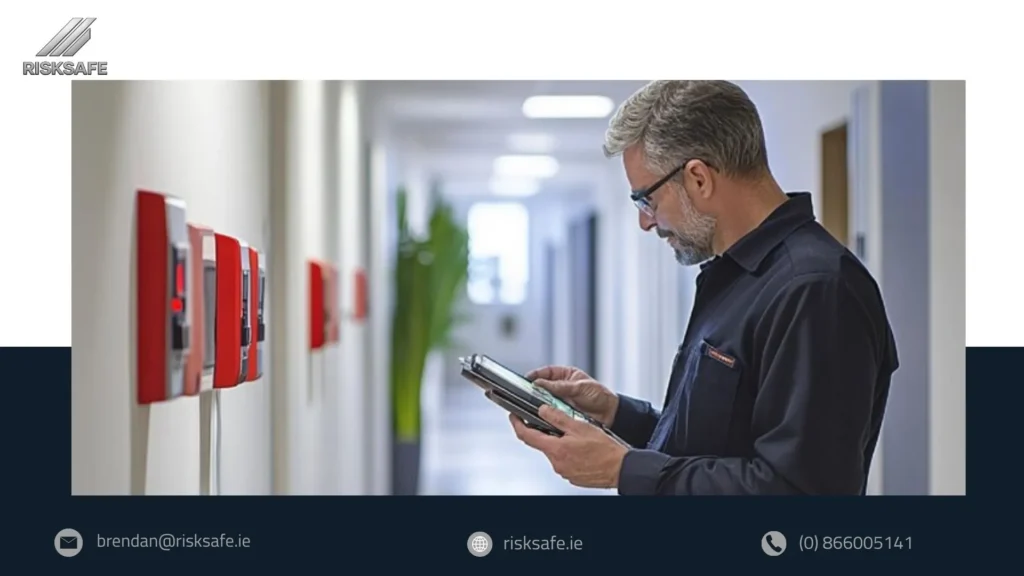
Watch how the door is used during a normal working day. A technically sound door can still be undermined by trolleys parked in its swing path, furniture preventing closure, or staff repeatedly propping it open. For workplace fire doors Dublin, observing everyday use often reveals problems during operations that a quiet inspection misses.
Stop People Wedging Fire Doors Open
One of the simplest inspection findings is also one of the most important: a fire door cannot perform its intended closing function if it is routinely wedged open.
Look for wedges, bins, extinguishers, furniture, hooks, or improvised devices holding doors open. Also check whether the door is difficult to use, because repeated wedging may indicate a practical problem such as poor access arrangements or an unsuitable closer.
Do not solve the issue only by removing the wedge today. Ask why employees keep using it.
If a hold-open solution is genuinely needed, it should be an appropriate fire-safety arrangement compatible with the door and alarm strategy, not an improvised object.
How Often Should Fire Doors Be Inspected Ireland?
Employers often ask how often should fire doors be inspected Ireland, but a single inspection interval should not be copied blindly across every premises.
The HSA requires fire-safety fixtures and fittings, including fire doors, to be kept in effective working order, with regular checks, periodic servicing, and maintenance. Any defects should be corrected as quickly as possible.
Dublin Fire Brigade’s Fire Safety Register template includes inspections across daily, weekly, monthly, three-monthly, six-monthly, and annual schedules and tells businesses to record the intervals at which inspections, tests, drills, and other fire-safety checks are completed.
The appropriate fire door inspection Dublin programme should reflect building use, door traffic, risk, previous defects, manufacturer information, fire strategy, and competent advice. A heavily used corridor door may need more attention than a rarely used protected-room door.
Record Defects So They Do Not Disappear Into Email
Dublin Fire Brigade recommends keeping fire-safety records and provides a Fire Safety Register that includes fire-door records. The register should remain available on the premises for inspection by Fire Officers.
Record the door location, inspection date, defect, responsible person, target date, and repair completion. Photographs can help track recurring problems.
For fire door maintenance Dublin, the key question is whether defects are actually closed. Repeated damage should trigger investigation into the underlying cause.
When the Checklist Should Lead to a Fire Risk Assessment
This article is intentionally informational. It explains checks that Dublin property and workplace teams can understand; it does not replace competent inspection, certification, repair, or a broader fire risk assessment.
If door defects appear alongside blocked escape routes, unsuitable compartmentation, alarm concerns, emergency-lighting issues, or changes in building use, the problem may be wider than one doorset.
RiskSafe’s Fire Risk Assessments Dublin is the main internal service page for organisations seeking a broader review of fire hazards and existing fire-safety arrangements. RiskSafe’s assessment process can consider fire doors alongside escape arrangements, emergency lighting, warning systems, fire equipment, and fire-safety management.
The article and service therefore target different search intent: fire door inspection checklist Ireland remains informational, while Fire Risk Assessments Dublin remains the commercial service page.
Connect Fire-Door Findings With Wider Workplace Management
Repeated wedging, delayed repairs, or damage from deliveries can reveal wider management problems. RiskSafe’s Health and Safety Audits Dublin can support a broader review of responsibilities and corrective actions.
Facilities teams can separately use Water Risk Assessments Dublin for water-system and Legionella risks.
Where handling work creates training needs after suitable controls are considered, RiskSafe also provides Manual Handling Training Dublin. These services remain separate from fire-door inspection.
Fire Door Inspection Checklist Ireland: A Practical Walk-Through
Use this fire door inspection checklist Ireland as a first-line visual review:
- Confirm the door is identified as a fire door and understand its intended rating.
- Check the leaf for damage, holes, warping, or unauthorised alterations.
- Inspect the frame and surrounding construction.
- Test whether the self-closer shuts the door reliably.
- Check hinges, screws, handles, latches, and relevant hardware.
- Inspect intumescent strips and smoke seals where required.
- Look for excessive or uneven gaps.
- Inspect glazing and vision panels.
- Remove wedges or obstructions.
- Check required signs are present and readable.
- Confirm escape-side operation is not obstructed by unsuitable locking.
- Record every defect and assign a responsible person.
- Escalate specialist defects to a competent fire-door professional.
- Recheck repairs after completion.
- Review recurring defects for an underlying cause.
The HSA also says doors on escape routes must remain available for use without a key, with appropriate opening devices used according to the risk.
For official guidance, read the HSA’s fire safety maintenance guidance, Dublin Fire Brigade’s Passive Fire Protection guidance, and its Fire Safety Register Template.
Frequently Asked Questions About Fire Door Inspection Requirements Ireland
-
Can employees carry out basic fire-door checks?
The HSA states that an employer or nominated employee can carry out checks and routine maintenance when suitably instructed and competent. Specialist inspection, repair, or certification should be handled by competent people where required.
-
Are door gaps part of an inspection?
Yes. Uneven or excessive gaps can indicate installation, movement, hinge, closer, or frame problems. Compare them with the manufacturer or tested doorset requirements. Dublin Fire Brigade specifically advises following manufacturer guidance on maximum gaps.
-
Is a wedged fire door a defect?
A wedge can stop a self-closing door performing its intended function. Remove the obstruction and investigate why wedging is happening.
-
How often should fire doors be inspected Ireland businesses?
Fire doors require regular checks and maintenance. Frequency should reflect premises use, door traffic, risk, previous defects, and relevant fire-safety information. The HSA requires regular checking, while Dublin Fire Brigade’s register structure supports recorded inspection schedules rather than one universal interval for every premises.
Treat Every Fire Door as a Complete Safety System
The strongest fire door inspection checklist Ireland does not end with a tick beside “door present.” It checks whether the complete assembly can still perform the function it was designed to perform.
For Dublin, Ireland employers and property teams, that means looking at the leaf, frame, closer, hinges, latch, seals, gaps, glazing, signs, surrounding construction, and everyday use. Record defects, repair them properly, and investigate repeated problems instead of accepting them as normal wear.
RiskSafe supports organisations through Fire Risk Assessments Dublin, where fire doors can be considered alongside escape routes, warning arrangements, emergency lighting, and other fire-safety controls. Keep fire door maintenance Dublin practical, documented, and connected to the wider fire-safety picture.