A laboratory report shows no Legionella detected. The result is filed and the building’s flushing, temperature checks and maintenance receive less attention. The same water-system weaknesses remain.
This is the risk of treating sampling as a pass-or-fail certificate. There is no single Legionella water testing frequency Ireland that makes every building safe. Testing can support a water safety programme, but its purpose, sampling locations and frequency should come from a competent assessment of the system and the people who may be exposed.
This guide answers how often to test for Legionella Ireland, explains when sampling may be appropriate and separates laboratory testing from the wider risk assessment and control process.
How Often Should Legionella Testing Be Carried Out?
For ordinary building hot and cold water systems, a universal testing interval should not be applied without considering the premises and water-system risk. The National Guidelines for the Control of Legionellosis in Ireland state that routine sampling to monitor control measures should be undertaken on the basis of a comprehensive risk assessment.
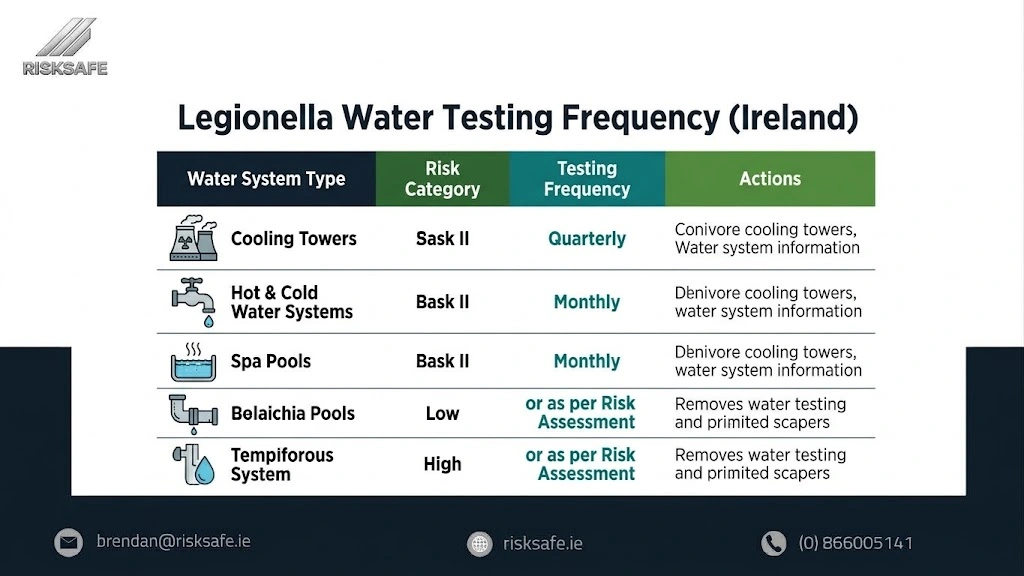
Some specialised or higher-risk systems have more specific guidance. The national guidelines recommend at least quarterly Legionella sampling for cooling tower systems. They also recommend six-monthly routine water sampling in healthcare facilities, including nursing homes and long-stay care institutions, with more frequent sampling for certain particularly high-risk patient areas.
Consequently, the correct Legionella sampling frequency Ireland arrangement depends on the type of system, purpose of sampling, effectiveness of controls, occupants and assessment findings. A schedule suitable for a cooling tower, spa pool or healthcare facility should not automatically be copied into a standard office or managed residential building.
The National Guidelines for the Control of Legionellosis in Ireland provide the primary reference for environmental sampling decisions.
What Does Legionella Water Testing Actually Show?
Legionella testing analyses water collected from selected points. Results can support contamination investigations, indicate whether colonisation appears local or system-wide and help evaluate control or disinfection measures.
A sample represents selected water at one place and time. It does not inspect every outlet or confirm future performance. Locations, timing, recent treatment, collection and transport can affect results.
A negative result does not prove that the complete system is safe. A positive result does not explain the cause by itself. Both must be interpreted alongside temperatures, system design, occupancy, outlet use, maintenance and the existing control plan.
Legionella Testing vs Risk Assessment
Understanding Legionella testing vs risk assessment prevents a common compliance mistake.
A Legionella risk assessment examines the water system and how it is managed. It considers storage, distribution, temperatures, low-use outlets, possible stagnation, aerosol generation, susceptible occupants, maintenance and existing controls. The objective is to identify where exposure could arise and what should be done about it.
Testing is narrower. It analyses samples collected from selected locations. It may form part of monitoring, validation or investigation, but it does not replace inspection of the system or evaluation of management arrangements.
The difference can be summarised as follows:
| Risk assessment | Water testing |
| Reviews the system, people and management arrangements | Examines samples from selected locations |
| Identifies foreseeable risks and control gaps | Provides results for the water sampled at that time |
| Determines whether and where sampling may be appropriate | Supports monitoring, validation or investigation |
| Produces recommendations for managing risk | Requires interpretation and possible corrective action |
RiskSafe’s Water Risk Assessment Dublin service reviews building water systems and existing controls. Sampling may be recommended separately where the circumstances justify it, but testing alone is not presented as a replacement for a suitable assessment.
When Is Legionella Testing Required?
The answer to when is Legionella testing required depends on the system, relevant guidance and reason for testing. Sampling may be appropriate in circumstances such as:
- Where the risk assessment or control plan identifies a justified monitoring need.
- When routine control parameters indicate that the system may not be operating effectively.
- After significant commissioning or recommissioning activity where validation is needed.
- When assessing the effectiveness of a new or corrective disinfection regime.
- Where repeated temperature, maintenance or water-quality failures raise concern.
- During investigation of a suspected case, cluster or outbreak under appropriate public-health direction.
- In systems or settings for which applicable guidance recommends routine microbiological monitoring.
- When previous results require follow-up sampling as part of corrective action.
Sampling needs a clear question. “We test every year” is inadequate if nobody can explain the selected outlets, meaning of results or required actions.
The Health and Safety Authority’s guidance on legionellosis explains that employers and people in control of workplaces should identify and assess risk, prepare a control plan, appoint a responsible person, implement controls and keep records showing whether the arrangements are effective.
Different Systems Need Different Testing Strategies
Standard Hot and Cold Water Systems
Routine sampling should be decided from the risk assessment rather than a universal calendar. A simple system with stable temperatures and effective controls may require a different approach from a complex building with tanks, long distribution routes, low-use areas or vulnerable occupants.
Cooling Tower Systems
The national guidelines recommend periodic Legionella sampling at least quarterly as part of the routine monitoring scheme for cooling towers. More frequent testing may be appropriate during commissioning, when establishing treatment or while confirming that a system has returned to control.
Healthcare and Vulnerable Settings
The national guidelines recommend six-monthly routine sampling in healthcare facilities, including nursing homes and long-stay care institutions. Certain areas caring for people at particularly high risk may need more frequent sampling. Current sector-specific guidance and competent advice should always be followed.
Spa Pools and Specialised Systems
Spa pools and other aerosol-generating systems may require defined microbiological monitoring because their temperatures, operation and exposure routes differ from ordinary taps. The relevant system-specific guidance, treatment programme and risk assessment should determine the programme.
These examples demonstrate why one answer to how often to test for Legionella Ireland would be unreliable. The building category alone is not enough; the actual system and exposure potential matter.
How Should Sampling Locations Be Chosen?
Collecting more bottles does not automatically create a better programme. Samples should be representative of separate water systems and selected to answer the purpose of testing.
Depending on the system, the sampling plan may consider:
- Stored cold water and hot-water generation points.
- Outlets near and far from storage or generation.
- Sentinel points selected to represent system performance.
- Low-use or problematic areas identified by the assessment.
- Areas serving occupants who may be particularly vulnerable.
The HPSC guidance says the number and type of sites should be decided for the individual system because plumbing, heating, ventilation and air-conditioning arrangements vary. Sample collection should be performed by people who understand Legionella ecology, risk and safe collection methods.
An effective Legionella sampling frequency Ireland programme therefore states not only when sampling occurs, but why each location is included and how consistent conditions will be maintained for meaningful comparison.
Timing Can Change the Meaning of a Result
Sampling immediately after disinfection may answer a different question from sampling during normal operation. Recent flushing, temperature changes, biocide dosing, reduced occupancy or shutdown can all influence the result.
Record operating conditions and factors affecting interpretation. Without context, results from different dates may appear comparable despite being collected under different conditions.
This is also why isolated testing should not replace routine control records. Temperature trends, outlet use and completed maintenance can reveal loss of control between sampling dates. RiskSafe’s guide to Legionella flushing frequency in Ireland explains how management of little-used outlets fits into the wider control programme.
What Should Happen After the Laboratory Result?
Every sampling programme should define escalation steps before results arrive. The appropriate response depends on the result, system, occupants, sampling purpose and relevant guidance.
Possible actions may include:
- Reviewing temperatures, flushing, treatment and maintenance records.
- Investigating whether the result is local or indicates a wider problem.
- Restricting or managing exposure where necessary.
- Cleaning, disinfection, repair or system modification by appropriate specialists.
- Reviewing the risk assessment and control plan.
- Resampling where justified to confirm the effectiveness of action.
Do not repeatedly sample without addressing likely causes or use a negative result to relax controls. Sampling does not replace good maintenance and water treatment.
Connecting Testing to the Control Plan
A suitable Legionella control plan in Ireland should identify the control parameters, monitoring methods, responsibilities, records and remedial actions relevant to the premises. If sampling forms part of the plan, it should specify:
- The purpose of testing.
- Systems and sampling points included.
- Frequency and timing.
- The competent sampler and laboratory arrangements.
- Information recorded at collection.
- Result-review responsibilities.
- Action and escalation criteria.
- When the sampling programme will be reviewed.
The appointed person should understand how results connect with other controls. RiskSafe’s article on the Legionella responsible person in Ireland explains how responsibilities can be assigned and monitored without assuming that one person must personally complete every technical task.
Common Legionella Testing Mistakes
Common weaknesses include:
- Applying an annual schedule to every premises without assessing risk.
- Sampling convenient outlets rather than representative points.
- Failing to record system conditions when samples are collected.
- Using a negative result as proof that no further control is needed.
- Repeating tests after an adverse result without correcting the cause.
- Testing while temperature, flushing and maintenance records remain incomplete.
- Allowing different contractors to sample inconsistently without a defined plan.
- Failing to review the risk assessment after loss of control.
- Confusing a laboratory report with evidence of complete compliance.
These errors produce data without necessarily improving safety.
When Should the Testing Programme Be Reviewed?
Review the programme after changes to the system, building use, occupancy, treatment regime or people who may be exposed. Review is also appropriate following adverse or unexpected results, prolonged shutdown, repeated control failures or significant maintenance work.
The underlying risk assessment must remain current. RiskSafe’s guide to Legionella risk assessment review frequency explains the changes and warning signs that may trigger reassessment.
Frequently Asked Questions About legionella water testing frequency Ireland
-
Is Annual Legionella Testing Required for Every Building in Ireland?
No universal annual testing rule applies to every building. The need and frequency should reflect the risk assessment, water system, occupants and applicable sector guidance.
-
How Often to Test for Legionella Ireland in an Office?
There is no automatic office interval. A competent risk assessment should determine whether routine sampling is justified and what existing controls need monitoring.
-
Can a Negative Result Replace a Legionella Risk Assessment?
No. It reflects selected samples at a particular time and does not examine the complete system, management arrangements or future performance.
-
When Is Legionella Testing Required After Disinfection?
Follow-up sampling may be recommended to validate corrective treatment, but its timing and locations should be defined by competent advice and the control plan.
-
Who Should Take Legionella Water Samples?
Sampling should be completed by appropriately trained people who understand Legionella risks, representative point selection, safe collection, transport and storage requirements.
-
Does RiskSafe Provide Laboratory Water Testing?
RiskSafe provides water and Legionella risk assessments. The assessment can identify when separate sampling or specialist investigation should be considered and how it fits into wider water safety management.
Test With a Purpose, Not Just a Calendar
The correct Legionella water testing frequency Ireland programme begins with a clear reason for sampling. It connects representative locations, competent collection, reliable analysis and predetermined action to a current assessment of the water system.
RiskSafe helps Dublin businesses, landlords, property managers and organisations understand their water-system risks through clear assessments and prioritised recommendations. Contact RiskSafe to discuss your premises and request a tailored water risk assessment quotation.