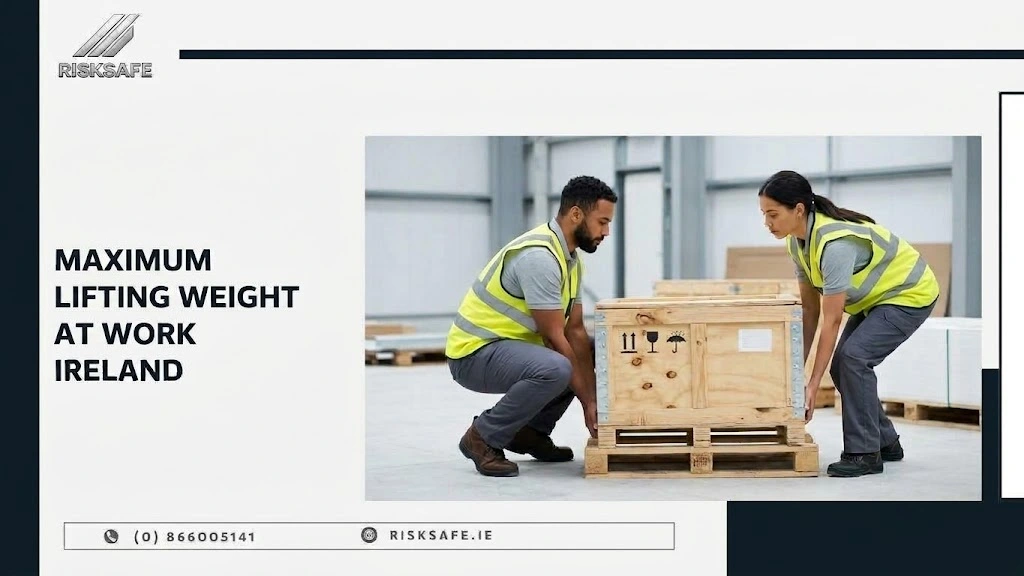
A Dublin employee is asked to move a box marked 24kg. Someone says it is safe because it is “under the 25kg limit”. That answer ignores the real question: can this load be handled safely by this person, in this place, as often as required?
There is no single maximum lifting weight at work Ireland employers can apply to every task. Irish requirements use a risk-based approach. Weight matters, but so do load stability, height, posture, distance, frequency and workplace conditions.
This guide explains the manual handling weight limit Ireland employers sometimes expect to find and what businesses should do before asking an employee to move a load.
Is There a Maximum Lifting Weight at Work in Ireland?
No fixed maximum weight is written into Irish legislation for every workplace lift. Searching for a legal lifting weight Ireland can therefore produce a misleading impression that one universal kilogram figure separates safe work from unsafe work.
Chapter 4 of Part 2 of the Safety, Health and Welfare at Work (General Application) Regulations 2007 addresses manual handling of loads. It requires employers to avoid the need for hazardous manual handling where possible. Where it cannot be avoided, employers must take organisational measures, use appropriate means and assess the work so that the risk—particularly the risk of back injury—is reduced.
The legislation does not say that every load below a specified weight is safe. It also does not say that every load above a particular figure is automatically prohibited. Consequently, the correct answer to how much can an employee lift in Ireland depends on the complete handling operation rather than the label on the box alone.
Why the Weight on the Box Is Only the Starting Point
Imagine two items that each weigh 15kg. The first is a compact container with secure handles, positioned at waist height beside its destination. The second is a wide, unstable package stored on the floor and carried up a narrow staircase. The numerical weight is identical, but the physical demand and potential for injury are very different.
The official Health and Safety Authority manual handling guidance identifies factors such as force, awkward posture, repetition, insufficient recovery time and workplace conditions. Employers therefore need to understand how the work is actually performed.
A suitable assessment may consider:
- The weight, size, shape and stability of the load.
- Whether the load has suitable handholds.
- The height from which it is picked up and where it is placed.
- Reaching, bending, twisting or holding the load away from the body.
- How often the handling is repeated and for how long.
- The distance travelled while carrying the load.
- Floors, steps, ramps, lighting, space and obstructions.
- The employee’s capability and any factors that may make the person particularly sensitive to risk.
- Whether a trolley, lift table or other suitable aid could remove or reduce the handling.
This is why a supposed manual handling weight limit Ireland rule should never replace observation of the real task.
The 25kg Lifting Limit Ireland Myth
The phrase 25kg lifting limit Ireland is frequently treated as though it were a legal permission: below 25kg is safe, while anything heavier is forbidden. That is not how Irish manual handling requirements operate.
A 25kg load may create an unacceptable risk when it must be lifted from floor level, handled repeatedly, gripped poorly or carried while twisting. A much lighter item may also be hazardous if it is bulky, unstable, sharp, hot or difficult to see over. Conversely, a heavier load might not require manual lifting at all if suitable mechanical equipment is used.
Screening tools can help a competent person decide which activities need closer examination, but they are not guaranteed safe limits. A workplace rule saying “one person may lift anything up to 25kg” should be replaced with a task-specific approach.
The key lesson is simple: the 25kg lifting limit Ireland employers sometimes rely on is not a universal legal limit, and being below that figure does not remove the employer’s responsibility to manage risk.
What Irish Employers Are Expected to Do
The process begins before technique or training is discussed. Employers should first identify handling activities that may create a risk of injury and ask whether the activity is necessary in its current form.
1. Avoid the Hazardous Handling Where Possible
Can the supplier deliver the item closer to where it will be used? Can materials be stored at a better height? Can a large load be divided into smaller units? Can the process be mechanised? Removing the lift is normally more reliable than teaching someone how to tolerate it.
2. Assess Handling That Cannot Be Avoided
The assessment should describe the actual task and record evidence rather than simply state “manual handling risk”. RiskSafe’s guide to a manual handling risk assessment in Ireland explains how the task, individual, load and environment can be reviewed systematically.
3. Introduce Practical Controls
Controls might include changing storage positions, reducing container size, improving access, rotating demanding activities, allowing recovery time or providing properly selected equipment. The RiskSafe guide to manual handling aids in the workplace explores how trolleys, lifting tables and mechanical solutions should be matched to the task.
4. Provide Suitable Information and Training
Employees need to understand the risks, the agreed system of work, the equipment provided and when they must stop and request assistance. Training supports the controls; it does not compensate for a load or layout that remains unnecessarily hazardous.
A Practical Way to Assess a Lifting Task
When the question how much can an employee lift in Ireland arises, walk through the operation instead of answering with a number:
- Task: Observe the starting and finishing heights, bending, twisting, sudden movement, repetition and time pressure.
- Individual: Consider capability, experience, competence and any relevant restrictions through an appropriate confidential process. One successful lift does not prove the task is safe for everyone.
- Load: Record its weight, dimensions, centre of gravity, grip and stability. Shifting contents can make a load less predictable.
- Environment: Check available space, floors, steps, lighting and pedestrian routes.
The Schedule 3 risk factors for manual handling provide an official reference for these considerations.
Examples: Why One Legal Lifting Weight Would Not Work
| Workplace situation | Why weight alone is insufficient | Possible next step |
| A box lifted once from waist height | Grip, reach and destination still affect risk | Position it close to the body and confirm a clear route |
| Small cartons handled hundreds of times | Repetition and limited recovery can build exposure | Redesign the workflow and reduce frequency |
| A large but relatively light package | Size may obstruct vision and force an awkward grip | Use a trolley or change the packaging |
| Stock taken from floor-level shelving | Bending and distance from the body increase demand | Raise frequently used stock to a better height |
| A trolley moved up a ramp | Starting force, slope, wheels and load stability matter | Assess pushing force, route and equipment condition |
| An unstable container shared by two people | Coordination and grip may remain poor | Use suitable equipment and a planned system of work |
Pushing and pulling may also constitute manual handling. Businesses using wheeled equipment can read RiskSafe’s guide to pushing and pulling risk assessment in Ireland.
Does Team Lifting Solve the Problem?
Adding a second person does not automatically make a lift safe or double the acceptable weight. Differences in height, reach or timing can distribute the load unevenly. Team handling can be a planned control, but the load, route, communication and coordination still require assessment. Suitable lifting equipment may be more dependable for heavy, awkward or frequently moved items.
This is another reason a fixed legal lifting weight Ireland figure would be inadequate: even the number of employees involved does not describe the whole risk.
When Manual Handling Training Is Appropriate
Training becomes relevant where risk remains after avoidance and physical improvements have been considered. Employees should learn to assess the activity before starting, use the agreed controls, recognise unsafe conditions and apply practical movement principles suited to their work.
RiskSafe provides Manual Handling Training Dublin for workplace teams involved in lifting, lowering, carrying, pushing, pulling or moving loads. Content can reflect the team’s roles, equipment, environment and common handling activities.
Training should not be booked merely to create a certificate that permits someone to lift a particular weight. If you need more detail on who may require instruction, read the guide to manual handling training requirements in Ireland.
What Employees Should Do Before a Lift
Employees should not calculate a personal maximum lifting weight at work Ireland figure. Before handling a load, they should know:
- What the item weighs and whether its contents can move.
- Where it is going and whether the route is clear.
- Whether equipment is available and suitable.
- Whether the load can be divided or repositioned.
- Who to contact if the task cannot be carried out safely.
Employees should report damaged equipment, unexpected load changes, restricted access and discomfort early. A near miss involving a dropped item or loss of balance can expose a problem before an injury occurs. RiskSafe’s guide to near miss reporting in Ireland explains how businesses can turn these warnings into corrective action.
Records That Demonstrate a Risk-Based Approach
Keep task assessments, load information, controls, equipment checks, training details and review dates. Update them when loads, layouts, equipment or working methods change. A wider Health and Safety Audit Dublin can review whether suitable documentation and controls are in place.
Frequently Asked Questions
-
Is There a Legal Maximum Lifting Weight at Work in Ireland?
No. There is no single statutory maximum lifting weight at work Ireland employers can apply to every task. The activity must be assessed and the risk controlled.
-
Is 25kg Safe for One Employee to Lift?
Not automatically. The 25kg lifting limit Ireland phrase is not a universal guarantee of safety. Posture, height, frequency, grip, distance, environment and individual capability all matter.
-
How Much Can an Employee Lift in Ireland?
It depends on the task. Employers should avoid hazardous handling where possible, assess unavoidable work and introduce suitable controls.
-
Does a Lighter Load Need a Risk Assessment?
A light object can still present risk when it is handled repeatedly, held away from the body, moved in an awkward posture or carried through an unsuitable environment. The need for assessment depends on risk, not weight alone.
-
Can Two Employees Lift Twice as Much as One Employee?
No simple calculation applies. Team handling introduces coordination, space, grip and load-sharing issues. It should be planned and assessed like any other handling activity.
-
Does Manual Handling Training Create a Legal Lifting Limit?
No. Training does not give an employee permission to lift any load below a stated weight. It should help employees recognise risk and follow controls selected for their actual workplace tasks.
Move Beyond the Number
Searching for the maximum lifting weight at work Ireland is understandable: a single number appears easy to communicate and enforce. In practice, it can create false confidence. The safer question is not “Is this under the limit?” but “Can we avoid this handling, and if not, what makes this task risky and how will we control it?”
RiskSafe helps Dublin organisations connect practical training with the handling activities employees actually perform. If your team lifts, carries, pushes or pulls loads and you need workplace-relevant instruction, contact RiskSafe to discuss your tasks, equipment and training requirements and request a tailored quotation.