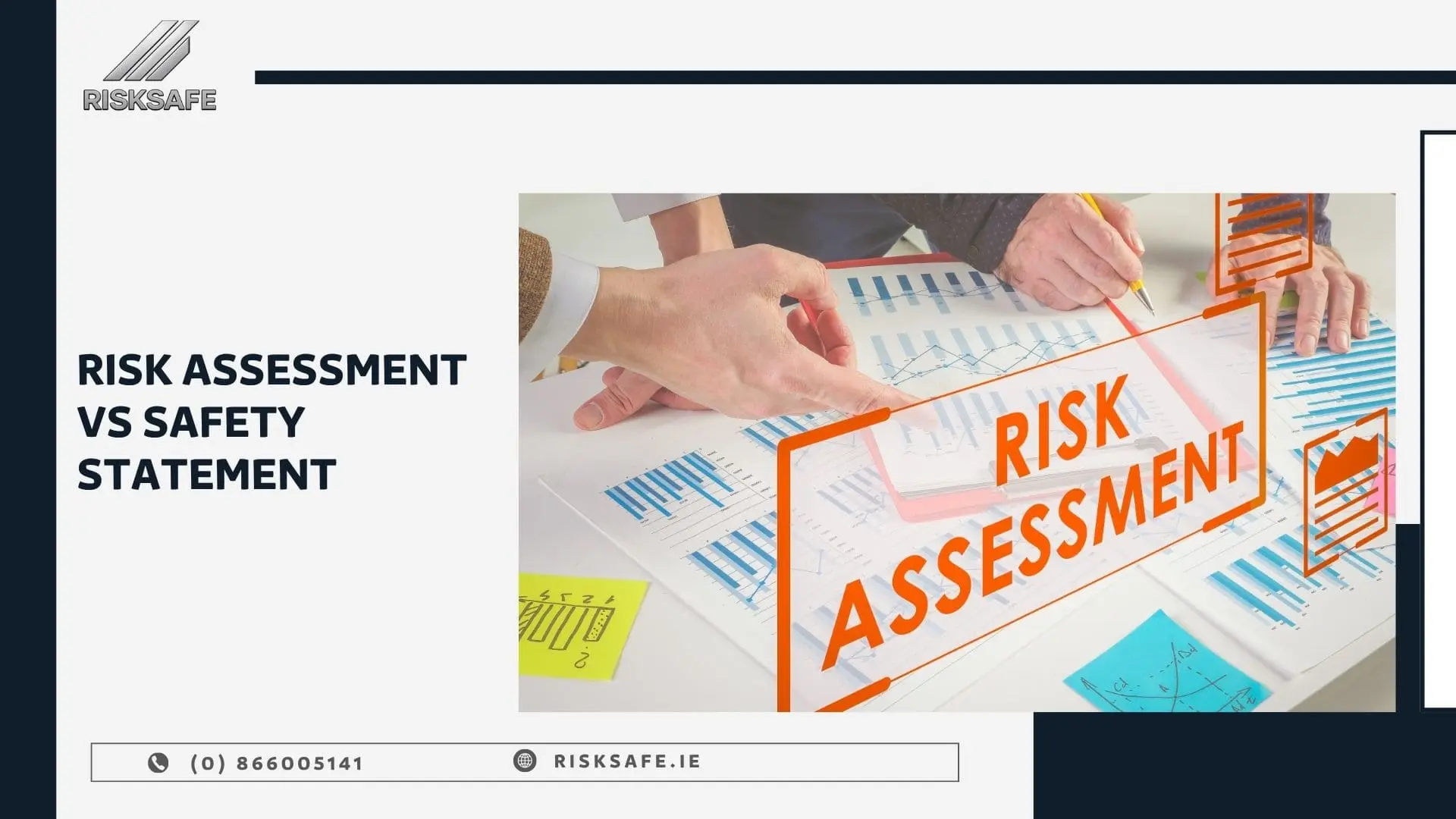
Risk Assessment vs Safety Statement is an important distinction for every Irish employer. A risk assessment identifies workplace hazards, evaluates the risks they create, and records the controls needed to prevent injury or illness. A Safety Statement is the wider written programme explaining how an organisation will manage safety, health, and welfare across the business.
The two documents are closely connected, but they are not interchangeable. Under Irish law, workplace risk assessments completed under Section 19 of the Safety, Health and Welfare at Work Act 2005 provide the foundation for the Safety Statement required under Section 20.
For Dublin businesses, understanding Risk Assessment vs Safety Statement supports compliance, HSA inspection readiness, and clearer responsibilities. Risksafe reviews both documents and recommends practical improvements.
This guide explains how each document works, where they overlap, when they require review, and how professional support can help Dublin employers turn legal duties into practical, measurable workplace improvements for their teams.
What Is the Difference?
The difference between risk assessment and Safety Statement is mainly their purpose and scope.
A risk assessment examines a hazard, task, work area, or employee group. It records who may be harmed, existing controls, and any additional action required.
A Safety Statement combines those assessments within a wider system covering policy, responsibilities, emergency arrangements, consultation, training, supervision, and review.
In simple terms, the risk assessment identifies and controls individual risks. The Safety Statement explains how the complete health and safety system will operate.
Risk Assessment vs Safety Statement Under Irish Law
Section 19 of the Safety, Health and Welfare at Work Act 2005 requires every employer to identify hazards in the workplace, assess the risks presented by those hazards, and possess a written assessment of risks to employees.
Section 20 of the Safety, Health and Welfare at Work Act 2005 requires every employer to prepare a written Safety Statement based on the hazard identification and risk assessment completed under Section 19. The statement must specify how employee safety, health, and welfare will be secured and managed.
This relationship is central to Risk Assessment vs Safety Statement. Employers should identify real hazards, complete suitable assessments, select controls, and use those findings to build or update the Safety Statement.
The Health and Safety Authority explains that risk assessments should form part of the Safety Statement. Therefore, Safety Statement and risk assessment Ireland duties should be managed together, even though each document performs a different function.
What Is a Workplace Risk Assessment?
What is a workplace risk assessment? It is a structured review of anything at work that could cause injury, ill health, or another form of harm. It evaluates the level of risk and determines whether existing precautions are sufficient.
A workplace risk assessment Ireland employers use should normally answer five practical questions:
- What hazards are present?
- Who could be harmed and how?
- What controls currently reduce the risk?
- What further improvements are required?
- Who will complete each action and when?
Hazards may include fire, manual handling, chemicals, machinery, electricity, vehicles, lone working, stress, contractors, or emergencies.
Assessments should also consider new starters, young workers, pregnant employees, disabled employees, lone workers, and anyone facing unusual risks.
A useful risk assessment is specific enough to guide action. Statements such as “staff must take care” or “appropriate precautions will be followed” do not clearly explain how risk will be controlled.
What Is a Safety Statement?
What is a Safety Statement? It is the employer’s written programme for managing safety, health, and welfare within the organisation.
It should explain the company’s safety policy, the responsibilities of managers and employees, the findings of risk assessments, the protective measures used, emergency procedures, training arrangements, consultation processes, and methods for monitoring performance.
The Safety Statement should identify safety resources and explain how employees receive understandable information, instruction, training, and relevant updates.
Unlike a single task assessment, a Safety Statement covers the organisation’s overall approach. It connects different risks and controls to a consistent system that managers can implement and employees can follow.
Risksafe’s guide to Safety Statement Ireland explains the document’s contents, legal role, review requirements, and value for Dublin employers.
Risk Assessment vs Safety Statement Comparison
The easiest way to understand Risk Assessment vs Safety Statement is to compare how each document is used.
Purpose
A risk assessment identifies hazards, assesses risk, and determines suitable controls. A Safety Statement explains how the organisation will manage workplace safety as a whole.
Scope
A risk assessment may cover one task, department, hazard, or group of workers. A Safety Statement covers the wider organisation, its responsibilities, arrangements, and relevant assessments.
Legal Basis
Written risk assessments are required under Section 19 of the 2005 Act. The Safety Statement is required under Section 20 and must be based on Section 19 assessments.
Content
A risk assessment records hazards, people at risk, existing controls, risk levels, additional actions, responsible persons, and review dates. A Safety Statement includes policy, responsibilities, assessments, controls, emergency arrangements, consultation, training, and monitoring.
Review Triggers
Both documents require review after significant change or when they may no longer be valid. An incident, new equipment, or changed process may trigger an assessment update and related Safety Statement amendments.
Why Employers Need Both Documents
Employers sometimes complete a Safety Statement but cannot produce detailed assessments supporting it. Others create separate assessments without connecting them to responsibilities, training, consultation, or emergency arrangements.
Neither approach provides a complete system.
Risk assessments supply the evidence behind safety decisions. They show why a control is needed and which people or tasks require attention. The Safety Statement turns those findings into an organised management programme.
Managing Risk Assessment vs Safety Statement correctly helps Dublin businesses show that safety is planned, communicated, implemented, and reviewed consistently.
Common Risk Assessment Mistakes
A frequent mistake is downloading a generic template and changing only the company name. This may leave important hazards unassessed while including risks that do not exist in the workplace.
Other common problems include:
- Assessing departments instead of examining real tasks.
- Using vague controls without measurable actions.
- Failing to involve employees who perform the work.
- Ignoring contractors, visitors, or vulnerable workers.
- Leaving actions without owners or deadlines.
- Applying one assessment to several different locations.
- Failing to review assessments after incidents or changes.
- Treating training as the only control available.
A professional workplace risk assessment Ireland review should compare documentation with actual conditions and work practices.
Common Safety Statement Mistakes
A Safety Statement may be legally required, but simply possessing a document does not show that the arrangements are effective.
Common weaknesses include outdated management names, incomplete risk assessments, emergency procedures that do not match the building, missing consultation arrangements, and controls that are not followed in practice.
An HSA inspector may compare the written statement with workplace conditions, employee knowledge, training records, equipment, and evidence that actions were completed.
Risksafe’s HSA Inspection Checklist can help employers review the evidence likely to be relevant before an inspection.
How Often Should Both Documents Be Reviewed?
The Safety, Health and Welfare at Work Act 2005 requires risk assessments to be reviewed following a significant change or where there is another reason to believe they are no longer valid.
A Safety Statement must also be reviewed following significant change, where it is no longer valid, or when an inspector directs that it be amended.
An annual management review is a useful routine, but employers should not wait for a calendar date when circumstances change.
Review may be needed after:
- New equipment, chemicals, or technology is introduced.
- A workplace opens, relocates, or changes layout.
- Employees begin new tasks or working arrangements.
- An accident, near miss, or complaint occurs.
- A control measure fails or proves ineffective.
- New information about a hazard becomes available.
- A contractor introduces additional risk.
- Legislation or authoritative guidance changes.
When an assessment changes, employers should consider whether the Safety Statement, employee instructions, training, or emergency procedures also require revision.
Who Should Prepare the Documents?
The employer remains responsible for suitable risk assessments and an implemented Safety Statement. Competent employees or consultants may assist, but responsibility remains with the employer.
The person completing the work should understand Irish safety requirements, risk assessment principles, and the organisation’s activities.
Employee participation improves accuracy because workers often recognise handling, access, equipment, or procedural problems that documents can miss.
Risksafe works with management and relevant employees to identify realistic hazards and create recommendations that can be applied in daily operations.
How Risksafe Helps Dublin Employers
Risksafe provides professional Health and Safety Audits Dublin for organisations that need a clear review of their workplace safety arrangements.
An audit can examine the Safety Statement, individual risk assessments, policies, training records, emergency procedures, contractor controls, incident reporting, employee consultation, physical conditions, and open corrective actions.
Risksafe compares documents with practice, identifies gaps, and prioritises actions so management knows what needs immediate or planned attention.
Our practical approach makes Risk Assessment vs Safety Statement easier to manage. Instead of treating the documents as separate paperwork, we help businesses connect hazards, controls, responsibilities, communication, and review.
Other Risksafe Services in Dublin
Risksafe also provides Fire Risk Assessments Dublin to identify fire hazards and review precautions, evacuation arrangements, and fire safety management.
Our Water Risk Assessments Dublin help organisations and property professionals assess water system risks and identify control improvements.
Manual Handling Training Dublin provides practical instruction for employees whose tasks involve relevant lifting, carrying, pushing, pulling, or moving risks.
Employers can also read our guides to Manual Handling Training Requirements Ireland and Manual Handling Certificate Expiry Ireland.
Checklist for Dublin Employers
Use this checklist to review Safety Statement and risk assessment Ireland arrangements:
- Are all significant workplace hazards identified?
- Are assessments written and specific to current activities?
- Do controls follow practical prevention principles?
- Are further actions assigned to responsible people?
- Does the Safety Statement reflect the assessments?
- Are responsibilities and emergency procedures current?
- Have employees received understandable information?
- Are training and consultation arrangements documented?
- Have changes, incidents, and complaints triggered reviews?
- Can management show that corrective actions were completed?
Several “no” answers may indicate that your documentation and workplace systems require professional review.
Book a Health and Safety Audit With Risksafe
Understanding Risk Assessment vs Safety Statement is the first step. The next is checking whether both documents accurately reflect your Dublin workplace and whether the controls described are working in practice.
Risksafe helps Irish employers move beyond generic templates and disconnected paperwork. Our audits provide a structured review, practical findings, and a clear improvement plan tailored to your organisation.
Risksafe can assist before inspections, after incidents, during premises changes, or whenever management needs an independent compliance review.
Contact Risksafe to discuss your workplace and request a Health and Safety Audit in Dublin.
Frequently Asked Questions
-
Is a Risk Assessment Part of a Safety Statement?
Yes. The Safety Statement must be based on hazard identification and written risk assessments. Relevant assessments normally form part of, or are clearly connected to, the statement.
-
Can One Risk Assessment Cover the Entire Workplace?
Sometimes a simple workplace may use broader assessments, but different tasks, locations, hazards, or employee groups often require separate assessments to remain accurate and useful.
-
Does Every Employer Need a Safety Statement?
The HSA states that all employers, including self-employed people, must have a Safety Statement relating to their workplace and work activities.
-
Can Risksafe Review Existing Documents?
Yes. Risksafe can review existing assessments and Safety Statements, compare them with workplace conditions, identify missing information, and recommend practical improvements.
-
What Is the Biggest Difference Between the Two?
A risk assessment evaluates particular hazards and controls. A Safety Statement describes the organisation’s complete system for managing safety, health, and welfare.
-
When Should I Contact Risksafe?
Contact Risksafe when documents are outdated, workplace activities have changed, an inspection is expected, an incident has occurred, or management needs an independent view of current compliance gaps.