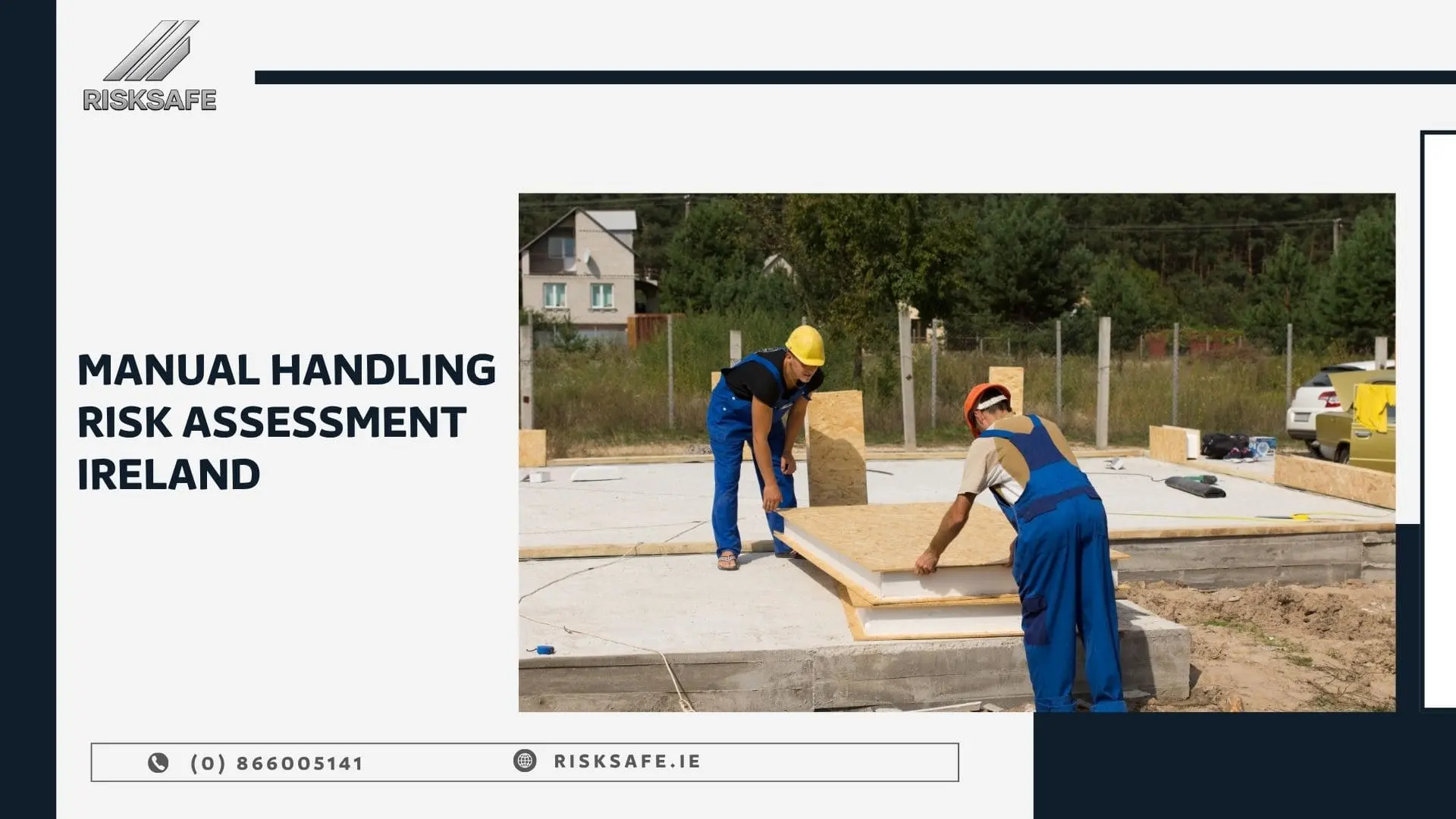
Manual handling injuries are not caused only by very heavy objects. Risk can also rise when employees repeat the same movement, twist while carrying, reach above shoulder height, lift from floor level, push awkward equipment or work in a restricted space. A manual handling risk assessment Ireland employers can rely on should examine the real task, the people completing it, the load and the workplace conditions. For Dublin businesses, that means assessing what happens in offices, warehouses, shops, hotels, healthcare settings, schools and facilities operations—not copying a generic lifting form.
This guide explains the legal approach, common manual handling hazards, the TILE method and a practical checklist.
The Legal Starting Point: Avoid the Task Before Teaching the Lift
Under Regulation 69 of the Safety, Health and Welfare at Work (General Application) Regulations 2007, employers must first take organisational measures or use appropriate means, particularly mechanical equipment, to avoid hazardous manual handling. Where it cannot be avoided, they must reduce the risk, assess the work and organise workstations to make handling as safe and healthy as possible.
This creates a clear order of priority:
- Avoid unnecessary manual handling.
- Use mechanical or organisational solutions.
- Redesign the task and workplace.
- Provide information, instruction, training and supervision for the remaining risk.
Training matters, but it is not a substitute for changing a badly designed task. The Health and Safety Authority’s guidance on manual handling training warns that simply sending employees on a generic course will not, by itself, reduce injury risk.
Does Every Lifting Task Need a Manual Handling Risk Assessment in Ireland?
Not every movement requires a long written form. The regulations apply where the task or unfavourable ergonomic conditions create a risk, particularly of back injury.
A quick screening review may be enough for a genuinely low-risk activity. A more detailed manual handling assessment Ireland workplaces use is appropriate where tasks involve:
- Heavy, bulky, unstable or difficult-to-grip loads.
- Repeated lifting, lowering, carrying, pushing or pulling.
- Twisting, stooping, reaching or working with the load away from the body.
- Long carrying distances or restricted recovery time.
- Uneven floors, steps, poor lighting or limited space.
- Sudden load movement or unpredictable contents.
- Workers whose capability may require additional consideration.
The assessment should focus on the complete operation, not only the stated weight.
Why There Is No Single “Safe Weight”
Irish manual handling rules do not set one universal safe lifting limit. Weight is only one factor. A lighter object may still create significant risk when it is handled frequently, held at arm’s length, moved from floor level, carried on stairs or gripped poorly.
The HSA’s guidance on managing manual handling in the workplace takes an ergonomic approach: fit the task to the person rather than expecting the person to overcome poor design. A workplace lifting risk assessment should therefore examine posture, repetition, distance, working height, grip, stability and environmental conditions alongside weight.
Use TILE—but Do Not Stop at the Acronym
The TILE manual handling assessment is a practical prompt.
T — Task: Study How the Work Really Happens
A detailed manual handling risk assessment Ireland employers complete should examine whether the work involves repetition, twisting, stooping, reaching, floor-level or overhead handling, long carrying distances, high pushing or pulling forces, sudden movements, an imposed work rate, or insufficient recovery time.
The task should be observed at its normal working speed. A demonstration arranged specifically for an assessor may appear safer than the way the work is actually completed during a busy Dublin shift.
I — Individual: Consider the Person, Not Just the Process
Consider capability, experience, knowledge, clothing, footwear and circumstances that may make a worker more sensitive to risk. Focus on whether the task or controls need adjustment and whether occupational-health advice is appropriate.
One assessment should not assume that every employee has the same reach, strength, mobility or experience.
L — Load: Look Beyond the Weight Label
Consider whether the load is:
- Large, unstable or difficult to see around.
- Hot, sharp, slippery or contaminated.
- Difficult to grip or unevenly balanced.
- Likely to shift or move suddenly.
- Supplied without clear weight information.
- Unsafe for one person to handle.
Regulation 69 also requires employees involved in manual handling to receive general indications and, where possible, precise information about load weight and the centre of gravity of the heaviest side where a package is eccentrically loaded.
E — Environment: Check the Entire Handling Route
A thorough manual handling risk assessment Ireland workplaces can rely on should examine floor condition, steps, slopes, lighting, temperature, ventilation, available space, storage height, and whether the load must be moved between different levels.
The working environment often explains why an ordinary handling task becomes hazardous. A box may be manageable when lifted at waist height but unsafe when picked up from a crowded storeroom floor and carried through a narrow stairwell.
TILE is useful, but the assessment should also address the full factors in Schedule 3 of the General Application Regulations, including the load, physical effort, working environment, activity demands and individual risk factors.
A Practical Manual Handling Risk Assessment Process
Step 1: Find the Tasks That Actually Matter
A practical manual handling risk assessment Ireland employers complete should begin with a walkthrough of the workplace to identify tasks where lifting, carrying, pushing, pulling, or moving loads forms a significant part of the job. Incident reports, employee concerns, near misses, and previous assessments should also be reviewed to identify recurring risks.
Employees who perform the work should be consulted throughout the process. HSA guidance highlights the importance of worker involvement because employees can identify awkward loads, restricted spaces, unsafe handling routes, and practical difficulties that may be missed during a desk-based review.
Step 2: Observe the Real Operation
Record:
- What is being moved.
- Starting and finishing heights.
- Frequency and duration.
- Carrying distance.
- Posture and grip.
- Equipment being used.
- Space and floor conditions.
- Differences between shifts or locations.
Where permitted, photographs or short task videos can help document the operation.
Step 3: Decide Who May Be Harmed and How
A complete manual handling risk assessment Ireland employers can rely on should identify possible outcomes such as back strain, shoulder injury, trapped fingers, collisions, slips, or loss of control of the load.
It should also consider new employees, temporary workers, young workers, pregnant employees, workers returning after injury, and anyone whose capability may make the task unsuitable without reasonable adjustment.
Step 4: Eliminate or Reduce the Risk
Strong controls change the task rather than relying entirely on employee technique.
Possible controls include:
- Removing the movement from the process.
- Arranging delivery to the point of use.
- Using trolleys, hoists, pallet equipment or conveyors.
- Reducing package size or weight.
- Improving handles or containers.
- Raising storage from floor level.
- Keeping frequent-use items between knee and shoulder height.
- Shortening carrying distances.
- Changing layouts or delivery routes.
- Reducing repetition and allowing recovery.
- Maintaining wheels, brakes and handling aids.
The regulations prioritise avoiding the handling operation where possible and using organisational measures or mechanical equipment to reduce the remaining risk.
Training should support these controls and reflect the actual task and equipment. RiskSafe’s guide to Manual Handling Training Requirements Ireland explains when instruction is needed and why it should follow risk assessment.
Step 5: Record Actions That Can Be Closed
A useful manual handling risk assessment template should record:
- Task, location and people exposed.
- Existing controls and identified risk factors.
- Required improvements.
- Responsible person, priority and deadline.
- Evidence needed for completion.
- Review date and trigger events.
Avoid vague actions such as “staff to take care.” A stronger action would be:
As part of a manual handling risk assessment Ireland process, provide a height-adjustable trolley for archive boxes, assign responsibility to the facilities manager, and verify that the equipment is being used correctly during the next workplace inspection.
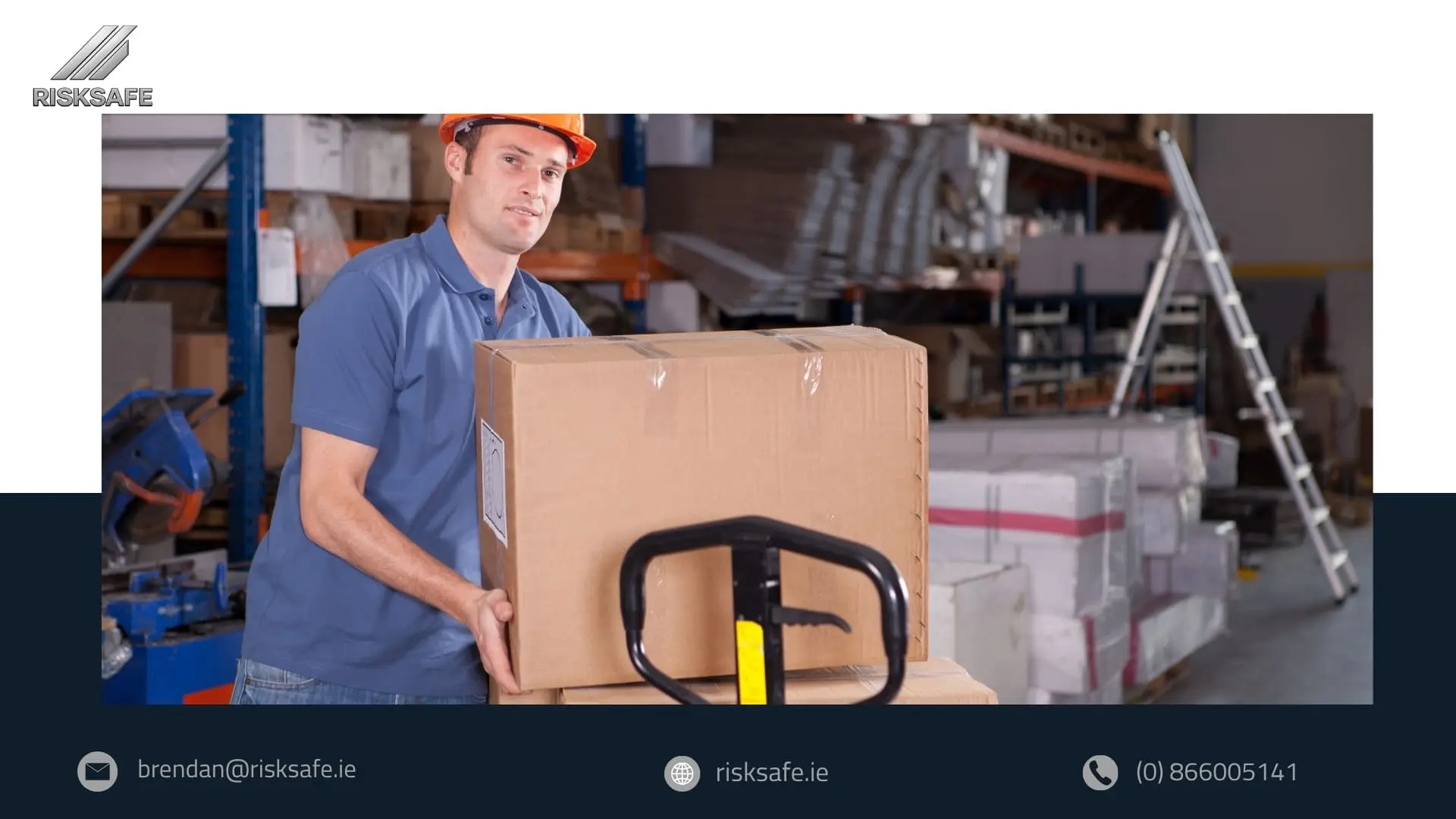
Manual Handling Risk Assessment Checklist
Use this checklist as a starting point for Dublin workplace tasks:
- Can the task be removed or completed differently?
- Can a mechanical aid reduce handling?
- Is the load’s weight known?
- Is it stable, balanced and easy to grip?
- Is it handled close to the body?
- Does the task involve twisting, stooping or reaching?
- Are handling heights suitable?
- Is repetition creating fatigue?
- Is the route short, clear and well lit?
- Are floors stable and non-slippery?
- Is there enough space to turn safely?
- Are storage heights suitable?
- Are individual capabilities considered?
- Is task-specific training provided?
- Are handling aids maintained and used?
- Are employees consulted?
- Are actions assigned and completed?
- Is the assessment reviewed after change or incident?
A manual handling risk assessment Ireland businesses use should not rely on a checklist alone when operations are complex or load weights vary. The HSA also identifies more detailed assessment tools, including the Variable Manual Handling Assessment Chart, which may be more suitable for tasks involving changing load weights and handling conditions.
When Should the Assessment Be Reviewed?
Review the assessment when:
- Loads, equipment, storage or workplace layouts change.
- Work volume or handling frequency increases.
- New employees or contractors perform the task.
- An injury, near miss or employee concern is reported.
- Existing controls are not being used or do not work.
- New handling equipment is introduced.
- The workplace relocates or is refurbished.
- The assessment no longer reflects actual practice.
A review should confirm that previous actions were completed and effective. Changing only the date on the form is not a meaningful reassessment.
Five Mistakes That Leave Manual Handling Risks Uncontrolled
1. Starting With Training
The law prioritises avoiding and reducing risk. Training should not be used to justify unnecessary lifting or a poorly designed workplace.
2. Assessing a Generic “Lift”
Assess the specific load, route, frequency, posture, equipment and people involved—not an imaginary standard lifting task.
3. Focusing Only on Weight
A weight figure does not show whether the load is unstable, repeatedly handled or moved through an awkward environment.
4. Treating Team Lifting as an Automatic Solution
Team handling can create coordination, visibility and communication problems. It needs to be properly planned.
5. Leaving Corrective Actions Open
An assessment is not complete when hazards are recorded. Someone must own each improvement and verify that it has been completed.
How the Assessment Fits Wider Safety Management
Significant manual handling findings should feed into the organisation’s written risk assessments and Safety Statement. RiskSafe’s guide to Risk Assessment vs Safety Statement explains the different roles of these documents.
Dublin employers may also use a broader Health and Safety Audits Dublin review to check whether assessments, training records, handling equipment and corrective actions are being managed consistently across the workplace.
Frequently Asked Questions
-
Is Manual Handling Training Enough Without a Risk Assessment?
No. Where manual handling creates a risk, employers must first consider avoiding the task, then assess and reduce the remaining risk. Training is one supporting control rather than the complete solution.
-
Is TILE a Legal Requirement in Ireland?
The acronym itself is not the legal test. It is a useful way to remember Task, Individual, Load and Environment. The assessment must still address the relevant factors under Regulation 69 and Schedule 3.
-
Who Should Complete the Assessment?
The assessor should understand the task, ergonomic risk factors and suitable controls. Where the necessary expertise is not available internally, HSA guidance says the employer should obtain competent assistance while remaining involved in the assessment process.
-
Can One Template Cover Every Task?
No. A template provides structure, but each assessment must reflect the actual task, workplace, load and people involved. Complex operations may require specialist tools or professional advice.
Build Safer Tasks, Not Just Better Paperwork
An effective manual handling risk assessment Ireland employers use should lead to visible change: fewer unnecessary lifts, better storage, appropriate equipment, safer routes and clearer responsibility.
For Dublin organisations, the strongest approach is to observe real work, involve employees, use TILE as a prompt, apply the full legal risk factors and prioritise elimination or redesign before relying on training.
Where employees still need practical, task-relevant instruction after controls are selected, RiskSafe provides Manual Handling Training Dublin. To discuss training needs or wider workplace arrangements, contact RiskSafe.