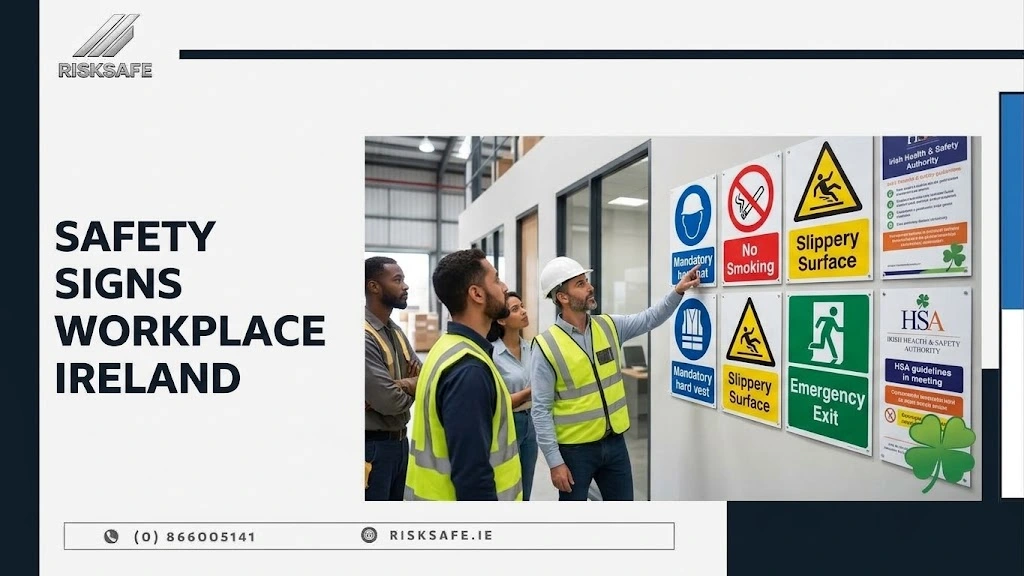
A workplace sign has only seconds to communicate. Whether someone approaches a restricted room or needs an emergency exit, the message must be visible, understood and connected to a real control.
Understanding safety signs workplace Ireland requirements involves more than buying standard symbols. Employers must identify where signs are necessary, select the correct type and ensure the instruction remains accurate.
This guide walks through a premises from its entrance to work areas, first aid and the final escape route.
The Essential Rule: Control the Hazard Before Adding a Sign
Under the Safety, Health and Welfare at Work (General Application) Regulations 2007, employers must provide safety or health signs where hazards cannot be avoided or adequately reduced through collective protection, work organisation, methods or procedures.
That order matters. A warning sign does not replace repairing a damaged floor, and an exit sign cannot make a blocked route safe.
The correct approach to workplace safety signs requirements Ireland is:
- Identify the hazard through risk assessment.
- Eliminate it where possible.
- Reduce the remaining risk using suitable controls.
- Provide signs where a residual risk or required action still needs to be communicated.
- Give employees relevant information and instruction.
- Inspect signs and update them when conditions change.
This connects signage directly to the Safety Statement and workplace controls.
Start at the Entrance: What Does a New Person Need to Know?
The entrance may require instructions about reception, vehicles, restricted access or protective equipment.
Do not cover the entrance with every rule used elsewhere. Display information that applies at that point and provide additional instructions before a person enters a particular risk area.
A visitor may not know the building or local arrangements. Use recognised pictograms and support them with induction or verbal instruction where necessary.
Employers must explain sign meanings and expected behaviour, especially to new and temporary staff.
Safety Sign Colours Ireland: A Fast Guide
The colour and shape allow people to recognise the type of message before reading any additional wording. The main safety sign colours Ireland workplaces use are:
| Colour and shape | Meaning | Typical workplace use |
| Red circle with diagonal bar | Prohibition | No smoking, no unauthorised access or a prohibited action |
| Yellow or amber triangle | Warning | Electrical danger, hazardous substance, moving vehicle or another hazard |
| Blue circle | Mandatory action | Eye protection, hearing protection or protective footwear must be worn |
| Green square or rectangle | Emergency escape or first aid | Emergency exit, escape direction, first-aid point or emergency facility |
| Red square or rectangle | Firefighting equipment | Location of an extinguisher, hose reel or other firefighting equipment |
Red can also indicate alarms, stopping and emergency shutdown. Green does not mean an area is free from every risk.
Consistent safety sign colours Ireland help recognition, but pictogram, shape, location and instruction also matter.
Moving Into the Work Area: Warning and Prohibition Signs
A warning sign highlights hazards such as vehicle movement, electricity, hot surfaces or overhead loads.
A prohibition sign communicates behaviour that is not permitted, such as smoking or unauthorised entry.
Before installing either type, ask:
- Is the hazard still present and accurately described?
- Can it be removed, guarded or separated more effectively?
- Who may approach the area?
- From which direction will they see the sign?
- Is the sign visible in the available lighting?
- Could another object, open door or stored material obscure it?
- Does the instruction remain valid during maintenance or changed operations?
A sign should communicate the hazard and required response before the person reaches the danger area.
Mandatory Workplace Signs Ireland: When an Action Is Required
The phrase mandatory workplace signs Ireland refers to signs communicating a specific behaviour or action. They are normally round with a blue background and white pictogram. Common examples instruct people to wear eye protection, hearing protection, safety footwear, gloves or another identified control.
Not every blue sign belongs in every workplace. The risk assessment must establish the required control; unnecessary PPE signs can conflict with actual procedures.
A mandatory sign does not provide or maintain protective equipment. Management must support it with suitable equipment, instruction and supervision.
Place the sign before entry to the relevant area and make boundaries between different requirements clear.
First-Aid and Emergency Facility Signs
Green rectangular or square signs can identify first-aid facilities, emergency exits, escape routes and other emergency equipment. Their purpose is to help people find assistance or safety quickly.
A first-aid sign must lead to an accessible facility. If it moves, update every directional sign; an outdated arrow can send someone away from help.
RiskSafe’s guide to workplace first aid requirements in Ireland explains why provision should reflect risk assessment rather than signage alone.
Fire Exit Signs Requirements Ireland: Follow the Entire Route
Exit signs should allow people to follow a recognisable route to a place of safety, not simply identify one green door.
When reviewing fire exit signs requirements Ireland, walk the route as a visitor. Check rooms, open areas, junctions, stairs and every change of direction.
The HSA states that workplaces must have clearly identified means of escape and that routes must be kept clear. Doors on escape routes must remain available without a key while the premises is occupied. Therefore, signs should be reviewed alongside:
- Clear corridors and stairs.
- Suitable exit doors and opening arrangements.
- Emergency lighting where required.
- Fire detection and warning.
- Arrangements for people who may need assistance.
- External routes leading to a place of safety.
- Employee information and fire drills.
A sign cannot correct an unsuitable route. RiskSafe’s Fire Evacuation Plan Ireland guide explains the complete evacuation journey.
Firefighting Equipment Signs Are Red, Not Green
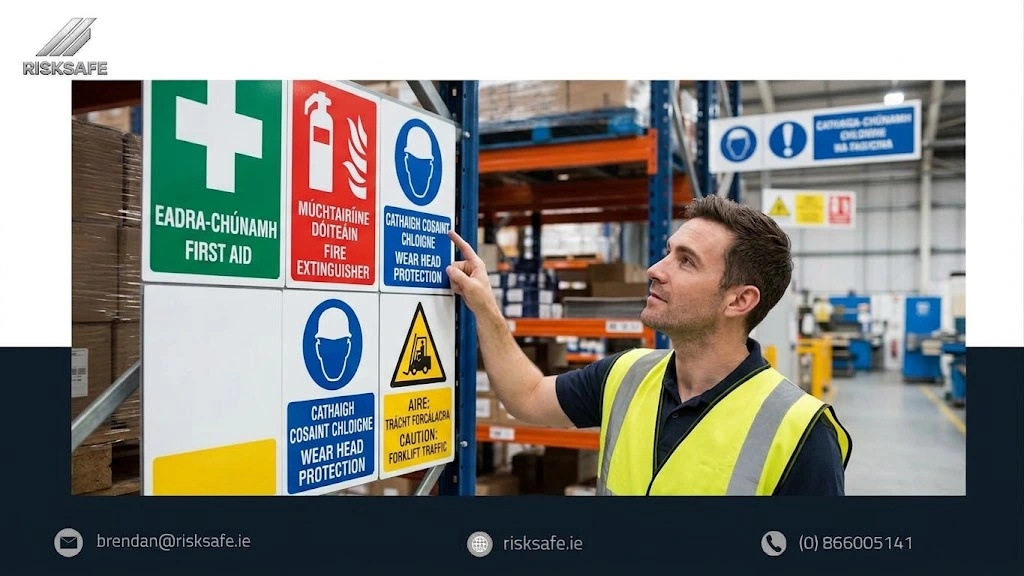
Firefighting equipment is identified using red rectangular or square signs with white pictograms. Signs or a safety colour—or both—are used to mark its location and identification.
The sign must point to equipment that is present and accessible. Neither should be blocked, and the equipment still requires inspection and maintenance.
Where several fire-safety issues appear together, use RiskSafe’s Fire Risk Assessment Checklist Ireland to review signage alongside alarms, emergency lighting, escape routes, doors, extinguishers and procedures.
Make the Message Visible and Understandable
A technically correct sign can still fail if people cannot see or interpret it. Position signs at an appropriate height and viewing distance, considering the normal direction of approach. Check them under the lighting conditions that exist during every occupied shift, not only in daylight.
Dust, condensation, glare, open doors, high shelving and temporary displays can all hide a sign. In outdoor or industrial areas, the material and fixing should withstand the environment. A sign that has faded until its colour is uncertain should be replaced.
The communication method must also suit the people affected. An acoustic or illuminated signal may be needed where a fixed sign cannot provide an immediate warning. Language, literacy, sensory impairments and unfamiliarity with the site should be considered in the risk assessment, induction and emergency planning.
Do not rely on extra wording to correct an ambiguous pictogram. Use recognised symbols and keep any supporting text short. Where employees must react to an alarm, hand signal or verbal instruction, training and practice should confirm that everyone understands the required response.
Avoid Sign Clutter and Conflicting Messages
More signs do not automatically improve safety. Poor positioning, deterioration and too many messages can reduce their effectiveness.
Remove obsolete signs, replace damaged ones and separate safety information from competing notices.
A “keep clear” notice beside permanent storage or an exit arrow leading to a locked door undermines every instruction.
A Practical Workplace Safety Sign Inspection
Use this short review for safety signs workplace Ireland management:
- Walk the workplace from each normal entrance.
- Check hazards against the current risk assessments.
- Confirm signs use the appropriate colour, shape and pictogram.
- View each sign from the direction people approach.
- Check lighting, height, distance and obstructions.
- Follow every emergency route to the final place of safety.
- Confirm marked equipment and facilities are present and accessible.
- Remove obsolete, duplicated or contradictory signs.
- Ask employees whether they understand the instructions and signals.
- Record defects, assign actions and verify completion.
For a broader review, RiskSafe’s Health and Safety Audits Dublin can examine signage alongside documentation, responsibilities, training, inspections and workplace controls.
When Should Safety Signs Be Reviewed?
Review signs after alterations, new machinery, revised traffic routes, different PPE requirements or emergency changes.
Check them after incidents, near misses, concerns or audit findings. Remove temporary signs when the associated work ends.
Routine workplace inspections should identify missing, damaged, obscured or misleading signs. RiskSafe’s guide to a Health and Safety Audit Checklist Ireland can help connect those observations to corrective-action management.
Common Safety Sign Mistakes
Common failures include using signs instead of controlling hazards, buying a generic pack without assessment, choosing the wrong colour, leaving old arrows and assuming every pictogram is understood.
The objective is not to cover walls with mandatory workplace signs Ireland symbols, but to communicate current and enforceable instructions.
Frequently Asked Questions
-
Are safety signs legally required in every Irish workplace?
Signs are required where risks cannot be avoided or adequately reduced by other protection measures, work methods or procedures. The actual signs depend on the workplace assessment.
-
What are the main safety sign colours in Ireland?
Red indicates prohibition or firefighting information, yellow or amber warns, blue requires an action, and green identifies emergency escape or first-aid information.
-
Does a safety sign replace employee training?
No. Employers must provide appropriate information and instruction about the signs and the behaviour employees should follow.
-
Must all employees wear PPE wherever a blue sign appears?
A blue mandatory sign communicates the specified required action in that area or task. The requirement should be supported by the risk assessment, suitable equipment, instruction and supervision.
-
Where should fire exit signs be positioned?
They should allow people to identify and follow the complete route, with additional directional signs where the next exit or change of direction is not clear.
-
What should happen when a workplace layout changes?
Review the risk assessment, emergency routes and sign locations immediately. Remove outdated signs and install any new signs before the changed area is used.
Make Every Sign Earn Its Place
Effective safety signs workplace Ireland arrangements are selective, consistent and connected to real controls. Each sign should answer one of three questions quickly: what is the hazard, what action is required, or where is safety equipment and the escape route?
RiskSafe supports Dublin organisations through professional health and safety audits and fire risk assessments. If signs are missing, contradictory or no longer match the workplace, contact RiskSafe to discuss the most appropriate assessment for your premises and receive clear, prioritised recommendations.