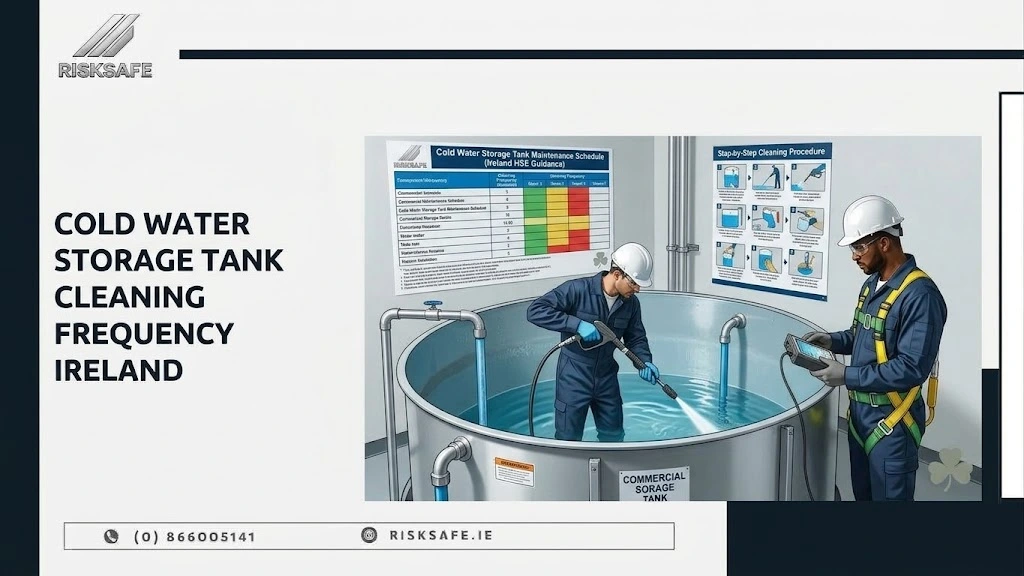
A cold water storage tank may look simple, but its condition can influence numerous outlets. Sediment, poor-fitting lids, corrosion, low turnover and rising temperatures may develop without an obvious problem at the nearest tap.
This makes cold water storage tank cleaning frequency Ireland an important question for employers, landlords, property managers and facilities teams. However, the safest answer is not “clean every tank on the same date”. Inspection should be planned, cleaning should respond to evidence and the complete programme should reflect a site-specific water risk assessment.
This guide explains the difference between inspection, cleaning and disinfection, plus the warning signs that should trigger action.
Is There a Fixed Tank Cleaning Frequency?
There is no single cleaning interval suitable for every cold water storage tank in every Irish building.
The National Guidelines for the Control of Legionellosis in Ireland include an annual visual inspection of cold water storage tanks, with remedial work carried out where necessary. Separate HPSC information recommends monthly inspection of water storage tanks and visible pipework to confirm, among other things, that lids and coverings remain intact.
These activities do not mean draining and disinfecting every tank monthly or annually. The cold water tank disinfection frequency should reflect tank condition, risk assessment, monitoring, building use and relevant sector guidance.
A sensible programme therefore combines:
- Routine external condition checks.
- Planned internal visual inspection by an appropriate person.
- Cleaning and disinfection when the assessment, condition or an incident indicates they are required.
- Clear records and verification that remedial actions were completed.
Higher-risk environments may follow more prescriptive arrangements that should not be copied automatically into an ordinary commercial building.
Inspection, Cleaning and Disinfection Are Not the Same Task
Confusing these three activities creates unnecessary cost at one extreme and inadequate control at the other.
Inspection looks for deterioration, contamination, temperature problems, damaged screens, insecure covers or other concerns. Internal inspection may require competent planning and access controls.
Cleaning removes sediment, scale and debris that can reduce disinfectant effectiveness and support biofilm.
Disinfection uses a controlled process to reduce microbial contamination. It requires suitable concentration, contact time, system management and safe return to use. Chemicals do not replace necessary physical cleaning.
The HPSC’s national guidance notes that significant sludge, scale and sediment may have to be removed before chemical disinfection can work effectively. Cleaning and disinfection should therefore be treated as controlled technical work rather than a general housekeeping task.
A Three-Level Schedule for Building Managers
Instead of searching for one universal number, manage cold water storage tank cleaning frequency Ireland through three levels of action.
Level 1: Routine Condition Checks
Facilities staff can check that the area is secure, covers and screens appear intact and no leak or deterioration is visible. Unusual odour, discolouration or water-use changes should be escalated.
These checks should be defined in the control plan, assigned to a named person and recorded. They should not require staff to enter a tank or disturb contamination.
Level 2: Planned Tank Inspection
National Legionella guidance includes annual visual inspection with remedial work where necessary. The inspector should understand when specialist assistance is needed.
This is the central answer to water tank inspection frequency Ireland: an annual planned visual inspection is an important baseline, supported by more frequent external oversight where appropriate. Conditions, previous defects or higher-risk users may justify additional inspections.
Level 3: Cleaning, Disinfection and Corrective Work
Cleaning may follow evidence of sediment, scale or contamination. Disinfection may be required after contamination, certain system work, an adverse result or prolonged loss of control.
The purpose is to maintain a suitable system—not simply produce an annual contractor certificate.
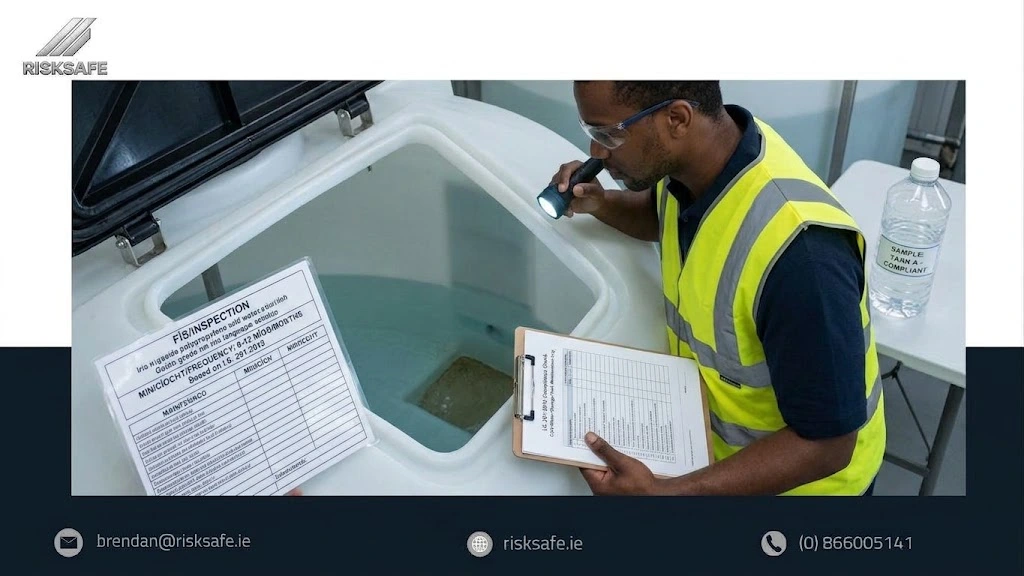
What Should a Cold Water Tank Inspection Examine?
A meaningful inspection should reflect access, tank type and competent advice. It may consider:
- Cover and access hatch: Are they intact, secure, correctly fitted and capable of preventing avoidable contamination?
- Screens and vents: Are overflow, warning and vent arrangements protected and in suitable condition?
- Internal condition: Is there sediment, scale, debris, corrosion, biofilm, staining or evidence of contamination?
- External condition: Are there leaks, damage, deterioration or signs that repairs have been delayed?
- Temperature and insulation: Is cold water maintained within the control strategy, without avoidable heat gain?
- Water turnover: Is the stored volume proportionate to demand, or could excessive storage encourage stagnation?
- Configuration: Could inlet and outlet positions create poor circulation?
- Access and records: Can work be completed safely, and do records identify the correct tank?
A Legionella water tank inspection should connect physical findings to the wider distribution system. A clean-looking tank does not prove that downstream pipework, little-used outlets or temperature controls are satisfactory.
When Does a Tank Need Cleaning?
Cleaning may be appropriate when inspection finds sediment, sludge, scale, organic material or corrosion products. It may also follow suspected contamination or intrusive work.
Consider prompt investigation when:
- Water shows unexplained discolouration, odour or debris.
- The tank cover, access hatch or protective screen has failed.
- Animals, insects, dust or other contaminants may have entered.
- Temperature or water-turnover records indicate persistent loss of control.
- The building has experienced prolonged closure or unusually low use.
- Plumbing alterations or maintenance may have introduced contamination.
- Sampling produces an adverse result and competent investigation identifies tank action.
- Previous inspection recommendations remain incomplete.
- The tank has not been accessible and its internal condition is unknown.
Address why deposits developed; unchanged storage, corrosion or contamination routes can allow the problem to return.
When Is Disinfection Required?
The correct cold water tank disinfection frequency is not necessarily a recurring calendar date. Disinfection should be justified by the water risk assessment, tank condition, relevant guidance, system work, monitoring evidence or competent advice.
Triggers can include suspected contamination, an adverse result, major alteration, entry for maintenance or loss of control. Healthcare premises should follow relevant HSE/HPSC guidance.
Incorrect concentration, contact time, flushing or return-to-service arrangements can fail or create additional risks. Competent people should plan and complete the work.
RiskSafe’s guide to the Legionella risk assessment legal requirements in Ireland explains why sampling and risk assessment have different purposes. A laboratory result can inform decisions, but it does not replace tank inspection, temperature control, maintenance or a current control plan.
Why Tank Condition Matters for Legionella Control
Legionella risk is affected by temperature, low flow, stagnation, biofilm, scale, sediment and corrosion. Oversized storage can reduce turnover, damaged insulation can allow warming and deposits can hinder treatment.
For that reason, Legionella water tank inspection should not be reduced to a photograph of the lid. It should help establish whether the tank remains suitable, whether controls are working and whether physical improvement is more appropriate than repeated treatment.
For more context on temperature management, read RiskSafe’s guide to the Legionella temperature range in Ireland.
Commercial Water Tank Cleaning Ireland: Define the Scope Before Booking
When arranging commercial water tank cleaning Ireland, define the scope. “Tank clean” may not include connected components, associated pipework, safe isolation, post-work flushing or a detailed report.
Before work begins, clarify:
- Which tanks and services are included, and why is the work required?
- How will occupants be protected and the system returned safely to use?
- What cleaning or disinfection method will be used?
- Are post-work checks or samples appropriate?
- What report and evidence will be supplied?
- Who will close remaining actions?
RiskSafe provides water risk assessment services, not routine tank-cleaning contracting. A professional Water Risk Assessment Dublin can help establish the system’s hazards, tank condition, control gaps and whether specialist maintenance or cleaning should be considered.
Connect Tank Management to the Legionella Control Plan
A tank schedule should sit inside a written control plan rather than operate as an isolated contractor visit. RiskSafe’s Legionella Control Plan Ireland guide explains how assessment findings can be turned into actions, responsibilities and records.
For each tank, record:
- A unique asset name and location.
- Tank type, capacity and areas supplied.
- Inspection frequency and responsible person.
- Expected temperature and condition criteria.
- Findings, maintenance reports and relevant photographs.
- Defects, actions and completion dates.
- Changes in building use or water demand.
Reports should be reviewed, not simply filed. RiskSafe’s guide to the Legionella responsible person in Ireland explains how duties can be coordinated.
Common Cold Water Tank Management Mistakes
Do not choose cold water storage tank cleaning frequency Ireland by copying another contract. Common mistakes include assuming inspection means automatic disinfection, treating a negative sample as proof of control and accepting reports that do not identify the tank.
Other failures include ignoring repairs, excessive storage, missed temperature reviews and undocumented responsibilities.
The strongest programme asks two questions after every finding: what caused it, and how will recurrence be prevented?
Frequently Asked Questions
-
How often should a cold water storage tank be inspected in Ireland?
National Legionella guidance includes annual visual inspection with remedial work where necessary. Routine external condition checks may be completed more frequently according to the control plan and risk.
-
Must every commercial water tank be cleaned annually?
Not necessarily. The cleaning schedule should reflect inspection findings, risk assessment, system condition and applicable sector guidance. Healthcare settings may require more prescriptive arrangements.
-
Is cleaning the same as disinfection?
No. Cleaning removes physical deposits; disinfection reduces microbial contamination through a controlled treatment. Where deposits are present, cleaning may be needed for disinfection to be effective.
-
Should a tank be disinfected after plumbing work?
It depends on the nature of the work and contamination risk. Significant alterations or intrusive maintenance may require disinfection based on competent assessment and applicable guidance.
-
Does a negative Legionella result mean the tank is clean?
No. It represents the sampled location and time. It does not confirm the complete tank and system are free from deposits, design problems or future risk.
-
Who should decide whether cleaning is required?
The decision should follow a suitable risk assessment, inspection evidence and competent advice. Technical cleaning and disinfection should be completed by appropriately competent providers.
Build the Schedule Around Evidence, Not Habit
The right cold water storage tank cleaning frequency Ireland programme begins with reliable inspection. It then uses the tank’s condition, system performance, building use and occupants to decide whether cleaning, disinfection, repair or redesign is appropriate.
For Dublin businesses, landlords and property teams, RiskSafe can review storage tanks alongside pipework, outlets, temperatures, low-use areas, records and management responsibilities. Contact RiskSafe to discuss a professional Water Risk Assessment Dublin and receive practical, prioritised recommendations for your premises.