Work-related stress may develop through excessive workloads, unclear priorities, repeated conflict, limited support or poorly managed change. By the time absence rises or staff leave, the problems may have existed for months.
A work related stress risk assessment Ireland employers can use should identify those work-related stressors early and turn evidence into practical improvements. It is not a test of who is “resilient enough”, a diagnosis of an employee’s mental health or a survey that disappears after people complete it.
This guide explains how to assess psychosocial hazards, consult employees, choose controls and connect results to the Safety Statement.
What Is Work-Related Stress?
Some pressure may be expected, but problems can develop when demands are not matched by a person’s abilities, resources or support.
Employers should examine work design and management factors that could cause harm when exposure is significant or prolonged.
A psychosocial risk assessment Ireland process may therefore consider workload, working hours, autonomy, management support, team relationships, bullying, role clarity, communication and organisational change. Physical working conditions, remote arrangements and exposure to critical incidents can also interact with these factors.
Individual support matters, but it should not replace correcting organisational problems.
The Irish Employer’s Responsibility
Section 19 of the Safety, Health and Welfare at Work Act 2005 requires employers to identify workplace hazards, assess the risks and hold written assessments. The findings should inform the Safety Statement required under Section 20.
The HSA explains that stressors can be workplace hazards capable of contributing to mental ill-health. Risk assessments should consider work-environment stressors, control measures, monitoring and review, with staff consultation.
The assessment should focus on factors generated or influenced by work and proportionate measures the organisation can take.
For an explanation of how assessments connect with the wider document, read RiskSafe’s guide to Risk Assessment vs Safety Statement.
Stress Risk Assessment Is Not an Employee Health Diagnosis
An organisational assessment looks for patterns in how work is designed and managed. It may examine teams, roles, shifts or locations, while protecting confidentiality and avoiding attempts to diagnose individuals.
An individual concern requires a sensitive response. Discuss work factors, consider changes, follow internal procedures and seek occupational-health input where appropriate. Handle medical information confidentially.
An employee stress risk assessment Ireland response should not begin by asking the employee to prove that work is the only cause. Instead, management should listen, establish which work factors may be contributing and decide what immediate and longer-term action is appropriate.
The two routes can inform each other without unnecessarily exposing private information.
Six Areas of Work That Deserve Attention
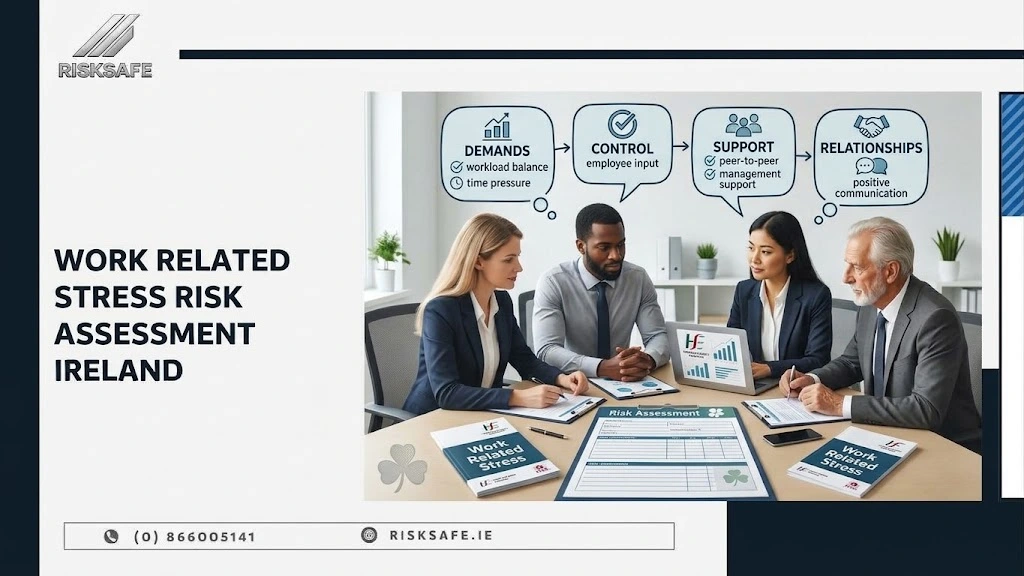
The HSA-supported Work PositiveCI process uses six workplace stressor areas.
1. Demands
Demands include workload, pace, working patterns and the work environment. Look for persistent overtime, unrealistic deadlines, repeated understaffing, conflicting priorities, inadequate breaks or work requiring sustained emotional effort.
Ask whether demand repeatedly exceeds the resources, time or competence available.
2. Control
Control concerns how much influence employees have over the way they complete their work. Extremely limited discretion, constant interruption or systems that prevent employees from organising reasonable aspects of a task can increase strain.
Even without complete autonomy, employees may contribute to methods, scheduling or improvements.
3. Support
Support includes access to information, resources, feedback and assistance from managers and colleagues. A policy saying “speak to your manager” is weak if managers are unavailable or concerns receive no response.
Check whether employees know where to seek help and whether remote, new or isolated workers receive suitable contact.
4. Relationships
Poorly managed conflict, unacceptable behaviour, bullying or harassment can become significant psychosocial hazards. The assessment should examine whether standards of behaviour are clear and whether people trust the reporting and resolution processes.
Specific issues may require dignity-at-work, grievance, disciplinary or bullying procedures rather than being grouped under “stress”.
5. Role
Employees need to understand their responsibilities, authority and priorities. Risk can increase where two managers give conflicting instructions, accountability is assigned without resources or a job changes without its expectations being clarified.
Job descriptions, induction and supervision should reflect the work actually performed.
6. Change
Restructuring, new technology, relocation, redundancy concerns or changes in management can create uncertainty. Harm is more likely when decisions appear without explanation, consultation happens too late or employees cannot see how the change affects their work.
Communication should be timely and two-way, including honest acknowledgement of what is not yet known.
How to Complete a Work Related Stress Risk Assessment Ireland
A credible assessment follows a process rather than one annual questionnaire. Work PositiveCI uses four stages: prepare, measure, action plan and review.
Stage 1: Prepare the Organisation
Secure senior commitment, define the scope, appoint a lead and explain how employees will participate and confidentiality will be protected.
Define included roles and locations. Avoid breakdowns that could identify people in small groups, and explain how information will be used.
RiskSafe’s guide to the Safety Representative Ireland role explains how employee representation can support meaningful consultation without transferring the employer’s responsibilities.
Stage 2: Measure the Hazards
Evidence may include a confidential survey, facilitated discussions, interviews, existing assessments and management information.
Indicators may include absence, overtime, turnover, grievances, missed breaks, errors, aggression or critical incidents. They do not prove causation but identify areas for investigation.
Organisation-wide averages can hide a struggling team, while very small groups can undermine anonymity.
Stage 3: Build an Action Plan
Share findings and consult on priorities. Give each action an owner, deadline and success measure.
Controls should address work design where possible. Examples include:
- Reviewing workload, staffing or deadlines.
- Clarifying priorities when demand exceeds capacity.
- Improving rotas, breaks or after-hours boundaries.
- Giving employees appropriate input into working methods.
- Training and supporting line managers.
- Clarifying roles and escalation routes.
- Strengthening conflict and bullying procedures.
- Improving communication before and during change.
- Reviewing support after aggression or critical incidents.
Wellbeing activities should not substitute for correcting workload, conflict or role problems.
Stage 4: Review Whether Controls Worked
Review whether each action changed the original hazard or created consequences elsewhere.
Measures can include employee feedback, excessive overtime, manager response times and relevant survey results. Absence figures alone are incomplete.
Communicate progress and delays; participation will weaken if findings disappear without explanation.

Consultation Must Feel Safe Enough to Produce Honest Evidence
The quality of a psychosocial risk assessment Ireland depends on whether employees believe they can speak honestly without being identified, dismissed or penalised.
Explain who can access raw information, how results are grouped and how serious concerns are handled. Managers should not receive identifiable survey responses without justification.
Report themes at a level that supports action without unnecessarily identifying individuals.
Publish a short results summary, priorities and progress updates to demonstrate action.
Managing Workplace Stress Ireland: Control the Source
Effective managing workplace stress Ireland arrangements distinguish organisational controls from individual support.
Organisational controls change the work: demand, staffing, clarity, communication, supervision, equipment, schedules or unacceptable behaviour. Individual support may include a management conversation, temporary work adjustment, occupational health guidance or access to an employee assistance programme where available.
Both can be appropriate, but resilience training cannot excuse predictable excessive hours.
Responses should be documented and reviewed. Managers should not diagnose or provide clinical treatment.
Give Line Managers a Clear Role Without Making Them Clinicians
Line managers often see workload changes, conflict and reduced support first, but they need a defined response. Train them to listen without making assumptions, record work-related concerns appropriately, explain available procedures and escalate matters that exceed their authority.
Managers should also know which changes they can approve, such as clarifying priorities or reallocating a deadline, and which require senior management, HR, occupational health or another specialist. Their role is to manage work and activate support—not diagnose the employee or promise confidentiality that cannot be maintained where serious safety concerns arise.
Remote and Hybrid Work Need Specific Questions
Remote work may introduce isolation, blurred hours, digital overload, weak support or unclear availability.
Consider roles, management, team contact and information access, including whether hybrid workers are disadvantaged.
A general employee stress risk assessment Ireland template may miss these differences unless remote and on-site conditions are examined separately.
When Should the Assessment Be Reviewed?
Review after restructuring, rapid growth, redundancies, new technology, shift changes, a major incident or evidence of control failure.
Repeated complaints, rising conflict, unusual turnover, sustained overtime or poor survey results should prompt earlier investigation. Review is also appropriate when a corrective action changes workload or responsibility elsewhere.
Record the evidence, changes, consultation and next review date.
Common Workplace Stress Assessment Mistakes
The most damaging mistake is running a survey without resources or commitment to act. Other problems include collecting identifiable information unnecessarily, treating low response as proof that no risk exists and publishing results without consulting on solutions.
Avoid placing every action under “employee wellbeing”. Managers should separate organisational hazards, individual support needs, bullying allegations, performance matters and personal data so each follows the right process.
A generic assessment copied from another business will rarely reflect actual roles, workload and culture. RiskSafe’s Health and Safety Audits Dublin can review whether risk assessments, consultation, responsibilities and corrective-action systems work together across the organisation.
Frequently Asked Questions
-
Is work-related stress a workplace hazard in Ireland?
Work-related stressors can be workplace hazards where they may cause harm. Employers should assess relevant work factors, implement controls and review their effectiveness.
-
Is a stress survey the same as a risk assessment?
No. A survey is one evidence source. The assessment must interpret findings, consult employees, identify controls, assign actions and review results.
-
Should an employer assess an individual employee’s mental health?
Managers should not diagnose employees. They should discuss work factors, respond sensitively, protect confidentiality and seek appropriate occupational-health support where necessary.
-
What should a workplace stress action plan contain?
It should identify each issue, the agreed control, responsible owner, deadline, expected outcome and method for reviewing effectiveness.
-
Can an employee assistance programme control workplace stress?
It may provide useful individual support, but it does not replace organisational controls for workload, role conflict, poor communication or unacceptable behaviour.
-
How often should the assessment be reviewed?
Use a planned review and reassess sooner after significant change, new evidence, repeated concerns or indications that controls are ineffective.
Move From Listening to Measurable Improvement
A useful work related stress risk assessment Ireland does not promise a workplace without pressure. It identifies preventable psychosocial hazards, gives employees a safe way to contribute and requires management to improve the way work is organised.
RiskSafe helps Dublin organisations examine workplace safety management through professional audits covering risk assessments, Safety Statements, consultation, responsibilities and action tracking. Contact RiskSafe to discuss your workplace and the appropriate scope for a Health and Safety Audit Dublin.