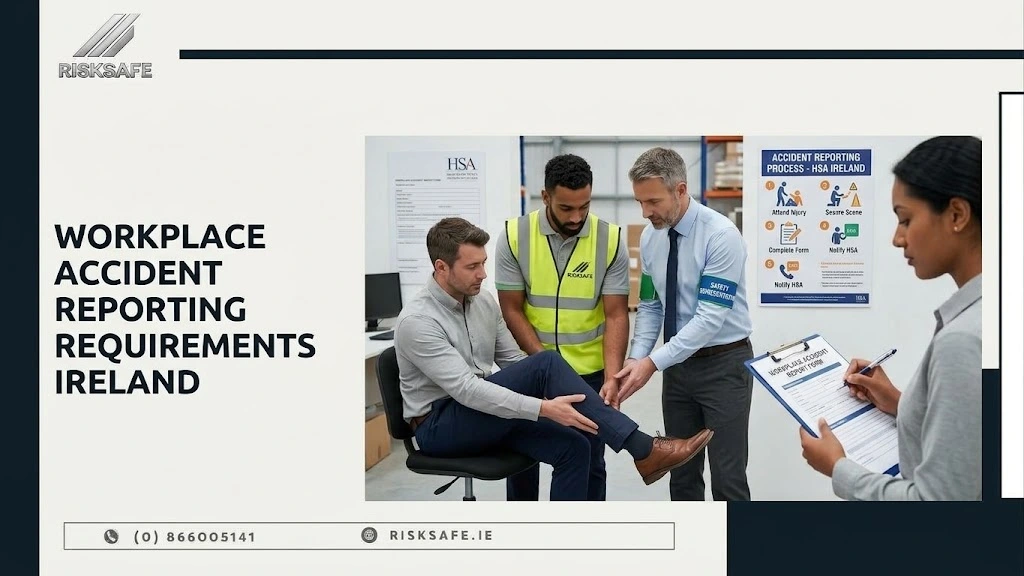
An employee slips beside a storeroom entrance. They finish the shift but cannot perform their normal duties for the rest of the week. The manager records the incident internally and waits. By the time reporting is considered, important details are difficult to confirm.
Situations like this make workplace accident reporting requirements Ireland important for employers and self-employed people. Not every cut, near miss or first-aid event must be sent to the Health and Safety Authority, but some accidents and specified dangerous occurrences are legally reportable within defined timescales.
This guide explains when to report workplace accident to HSA, how the widely misunderstood three-day rule works, when an IR1 form Ireland report may be needed and why statutory reporting should be followed by a proportionate investigation.
When Is an Accident Reportable?
Under the Safety, Health and Welfare at Work (General Application) Regulations 2016, an employee injury arising from an accident at work is reportable when it prevents the employee from performing their normal work for more than three consecutive days. The day of the accident is excluded, but days that would not normally have been working days are included.
Fatal accidents, certain injuries involving non-workers and specified dangerous occurrences can also be reportable.
The official HSA accident and dangerous occurrence reporting guidance should be checked when deciding whether an event meets the formal criteria. This article provides general information and is not a substitute for advice about a particular incident.
Understanding the Three Day Accident Reporting Rule Ireland
The phrase three day accident reporting rule Ireland can be misleading. It does not mean that every injury lasting exactly three days must be reported. The threshold applies where the employee is prevented from carrying out their normal work for more than three consecutive days, excluding the day of the accident.
For example, suppose an employee is injured on Monday and cannot perform normal duties on Tuesday, Wednesday, Thursday and Friday. Monday is excluded. The following four consecutive days indicate that the reporting threshold may be met, even if some of those days would not usually have been working days.
Employers should focus on whether the employee can carry out normal work, not only whether the person is completely absent. Moving an injured employee onto restricted or alternative duties may still mean they were prevented from performing their normal duties. The facts should be documented carefully and checked against current HSA guidance.
The three day accident reporting rule Ireland is only one part of the framework. A fatality, injury to a non-worker or prescribed dangerous occurrence may follow different criteria, so businesses should not use the three-day threshold as the only reporting test.
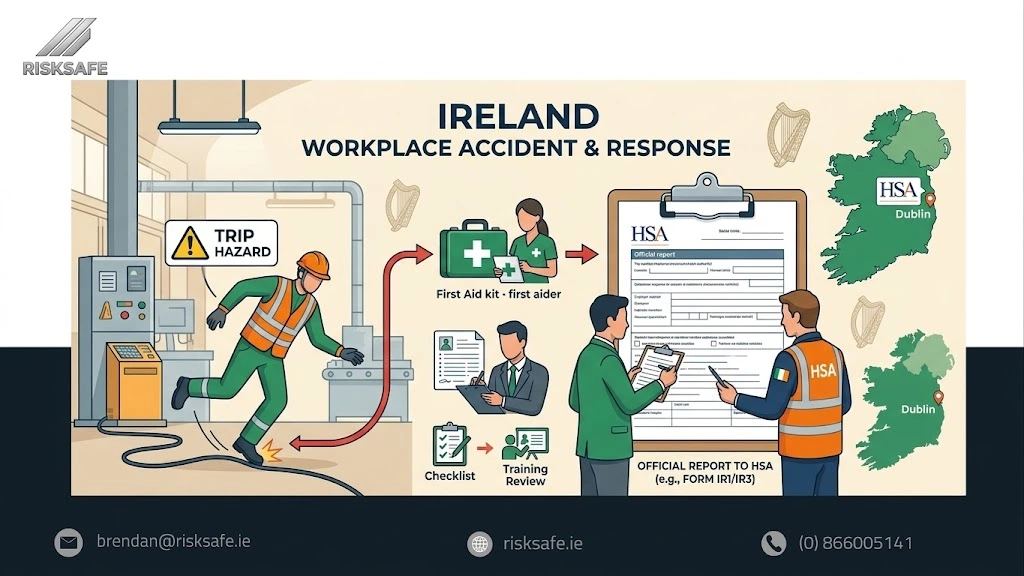
Step 1: Respond to the Incident First
The immediate priority is people. Arrange first aid, make the area safe without creating further risk and contact emergency services when necessary.
Preserve relevant evidence without obstructing medical care or leaving a hazard uncontrolled. Evidence may include photographs, CCTV, equipment condition, witness details and training records.
Fatal accidents must be notified immediately to the HSA or An Garda Síochána by the quickest practicable means. A formal report must then be submitted to the HSA within five working days of the death. Non-fatal reportable accidents and dangerous occurrences should be reported as soon as reasonably practicable and no later than ten working days after the event.
These timescales come from the 2016 Reporting of Accidents and Dangerous Occurrences Regulations.
Step 2: Create an Internal Accident Record
An incident that does not meet the HSA threshold may still need to be recorded and investigated internally. An early factual record helps the employer understand what happened, decide whether the event may become reportable and identify immediate corrective actions.
A useful record may include:
- Date, time and precise location.
- The person involved and the work being carried out.
- A factual description of what happened.
- Injury details and immediate assistance provided.
- Witness names and available evidence.
- Normal duties the employee cannot perform.
- Initial controls introduced after the event.
Avoid blame, assumptions or copied conclusions. The initial record should distinguish known facts from information that still requires confirmation.
Step 3: Decide Whether to Report Workplace Accident to HSA
To decide whether to report workplace accident to HSA, consider the injured person, the connection with work, the outcome and the duration of incapacity.
Employee Injuries
An accident may be reportable where an employee dies or is prevented from performing normal work for more than three consecutive days, excluding the accident date. The accident may occur at the normal workplace or while the employee is carrying out work elsewhere.
People Who Are Not at Work
An accident involving a non-worker may be reportable where the person dies or is taken from the accident location to receive treatment at a hospital or medical facility.
Fatal Accidents
A fatal event requires immediate notification, followed by the formal report. An employer should not wait for the normal online reporting timetable before making the initial notification.
Dangerous Occurrences
Some high-potential events are reportable even if no injury occurs. These are considered separately from ordinary near misses and must fall within the prescribed categories.
If the circumstances are unclear, consult the detailed HSA guidance or contact the HSA rather than allowing a reporting deadline to pass.
How to Submit an IR1 Form Ireland Report
The IR1 form Ireland is used for reporting workplace accidents. The HSA provides an online accident reporting system, allowing registered users to submit reports, view their reporting history and print copies for their records.
A paper IR1 can also be requested from the HSA Contact Centre and returned to the address specified by the Authority. The HSA’s official guide to reporting workplace accidents and dangerous occurrences explains the available reporting routes.
Before completing an IR1 form Ireland submission, gather accurate information about:
- The employer and workplace.
- The injured person.
- The accident location and date.
- The work activity involved.
- The nature of the injury.
- What happened and any equipment involved.
- The effect on the employee’s normal duties.
Do not delay a required submission simply because the entire internal investigation is unfinished. The statutory report and the investigation have related but different purposes. Submit accurate information available within the required timeframe and retain the confirmation with the incident records.
Dangerous Occurrence Reporting Ireland
Dangerous occurrence reporting Ireland applies to specified events with serious potential, even when good fortune prevents an injury. The regulations contain a prescribed list, and the HSA guidance provides examples and explanatory notes.
Categories include certain collapses, equipment failures, electrical incidents, explosions and other defined events. A near miss is only a statutory dangerous occurrence when it meets a prescribed description.
The distinction matters:
| Event | Internal record | Formal HSA report |
| Minor injury below the statutory threshold | Usually appropriate | Not automatically required |
| Near miss not matching a prescribed category | Good practice | Not normally required under these regulations |
| Employee unable to perform normal work for more than three consecutive days | Required for management and evidence | Generally reportable |
| Prescribed dangerous occurrence | Required | Reportable even without injury |
| Fatal work-related accident | Required | Immediate notification and formal report required |
For detailed dangerous occurrence reporting Ireland criteria, consult the HSA’s current list rather than deciding from the everyday meaning of “dangerous”.
Accident, Near Miss and Dangerous Occurrence: Do Not Mix Them Up
An accident causes injury or loss. A near miss reveals potential harm without causing it on that occasion. A dangerous occurrence is a legally defined event that may be reportable without injury.
RiskSafe’s guide to near miss reporting in Ireland explains how internal near-miss systems can capture warnings without suggesting that every near miss must be submitted to the HSA.
All three can justify investigation. A falling object may expose a storage failure, while a minor slip might reveal a recurring housekeeping problem. RiskSafe’s slips, trips and falls risk assessment guide examines common causes and controls.
Reporting Does Not Replace Investigation
Submitting a form completes a reporting duty; it does not prevent recurrence. A proportionate investigation should look beyond the employee’s final action and examine the conditions that allowed the event to happen.
Questions may include:
- Was the risk assessment suitable and current?
- Was the system of work realistic under normal operational pressure?
- Were employees given relevant information, instruction and supervision?
- Was equipment suitable, inspected and maintained?
- Had similar concerns or near misses been raised before?
- Did layout, workload, staffing or communication contribute?
- Were agreed controls actually being used?
Corrective actions need owners and completion dates. The risk assessment and Safety Statement may also require updating. RiskSafe’s guide to risk assessment vs Safety Statement explains their relationship.
Common Workplace Accident Reporting Mistakes
Mistakes usually arise from delay, assumptions or an unclear internal process. Examples include:
- Counting the day of the accident within the three-day period.
- Counting working shifts only instead of consecutive calendar days.
- Looking only at absence and ignoring inability to perform normal duties.
- Assuming every near miss must be formally submitted.
- Failing to check whether a no-injury event is a prescribed dangerous occurrence.
- Waiting for the investigation to finish before making a time-sensitive report.
- Treating the IR1 submission as the end of corrective action.
- Keeping no evidence of the report or follow-up decisions.
A clear procedure should assign responsibility for receiving notifications, assessing reportability, submitting reports and monitoring corrective actions.
Build Reporting Into the Safety Management System
Effective workplace accident reporting requirements Ireland arrangements should work on an ordinary day, not only after a serious event. Employees need a simple way to raise accidents and near misses, while managers need clear escalation criteria and access to accurate records.
A Health and Safety Audit Dublin can review incident procedures, risk assessments, training records, inspections and corrective-action tracking as part of the wider safety management system. Businesses preparing for regulatory scrutiny can also use RiskSafe’s HSA inspection checklist to review the documents and evidence they may need.
Frequently Asked Questions
-
When Must an Employer Report Workplace Accident to HSA?
Reportable events include certain fatalities, employee injuries preventing normal work for more than three consecutive days and specified injuries to non-workers. Check the current HSA criteria for the individual event.
-
Does the Three-Day Period Include Weekends?
Yes. The three day accident reporting rule Ireland excludes the accident date but includes consecutive days that would not have been working days.
-
What Is the Deadline for a Non-Fatal Reportable Accident?
It should be reported as soon as reasonably practicable and no later than ten working days after the event.
-
What Is an IR1 Form Ireland Report?
It is the approved accident-reporting form. Employers can generally submit accident reports through the HSA online system or request the paper form.
-
Must Every Workplace Near Miss Be Sent to the HSA?
No. Near misses should normally be recorded and reviewed internally, but formal reporting applies when an event meets the criteria for a prescribed dangerous occurrence or another reportable category.
-
Can We Wait Until the Investigation Is Complete?
Do not allow the reporting deadline to expire. The required HSA report can be submitted using accurate available information while the internal investigation and corrective actions continue.
Turn Every Report Into Prevention
Understanding workplace accident reporting requirements Ireland protects more than legal compliance. A prompt report preserves information, while a thoughtful investigation shows where equipment, procedures, supervision or risk controls need to improve.
RiskSafe supports Dublin businesses and organisations through practical health and safety audits that examine documentation and how controls operate in the workplace. To review your incident procedures, risk assessments and corrective-action systems, contact RiskSafe and request a tailored audit quotation.